
A practical Dubai guide to choosing acrylic desk partitions for offices, clinics, reception counters, retail stores, schools, pharmacies, banks and customer service desks.
If you need clear desk dividers, reception counter shields, clinic sneeze guards, or removable office screens in Dubai, this guide helps you choose the right thickness, size, base type, fixing method and finishing standard.
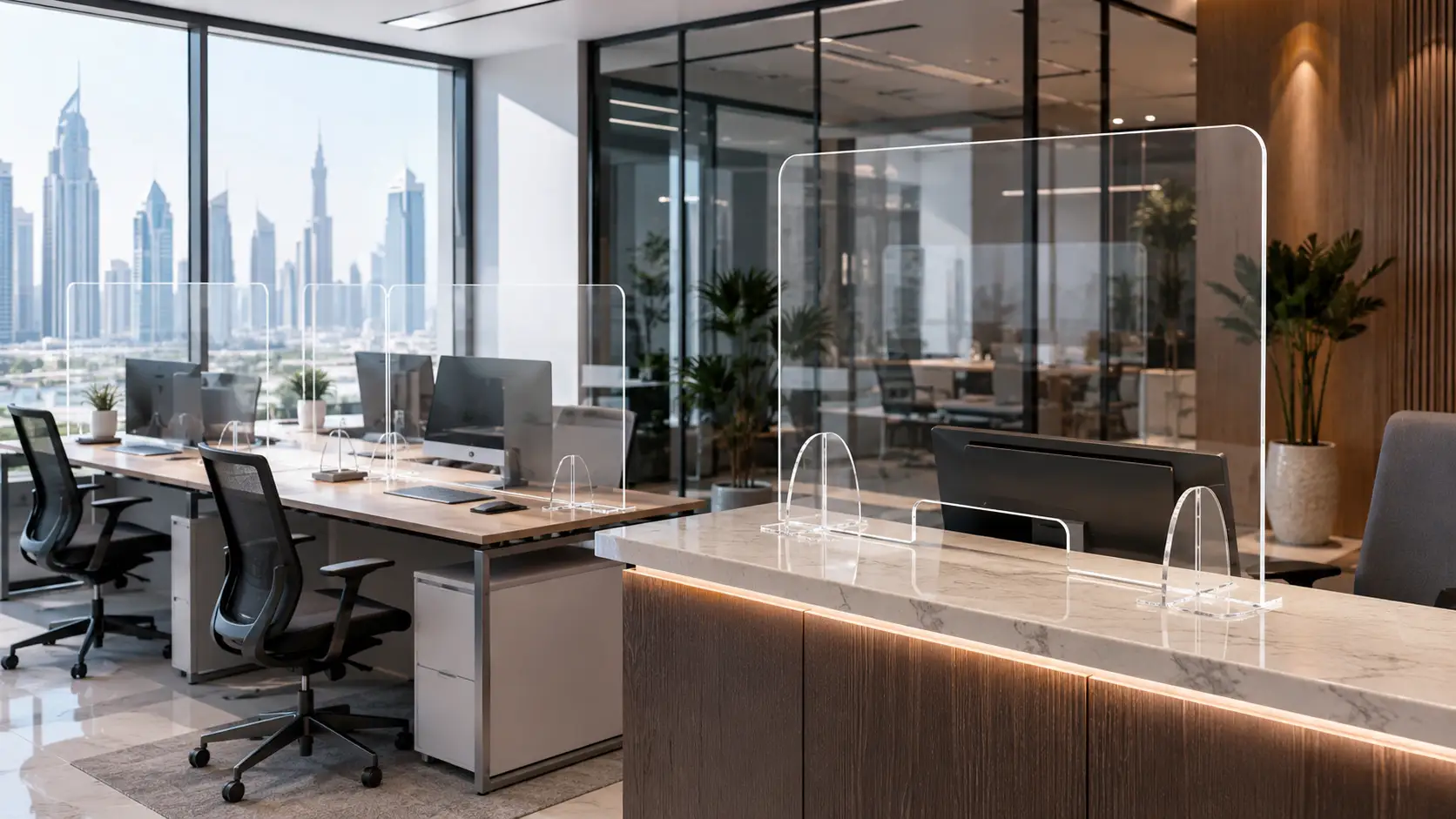
Acrylic desk partitions have become a practical choice for Dubai offices, clinics, reception counters, retail stores, schools, banks, pharmacies and service desks. They are clear, lightweight, easy to customize and quick to install. More importantly, they help create cleaner work zones without making a desk, counter or reception area feel closed off.
If you are planning acrylic desk partitions Dubai workplaces can use for privacy, splash protection, customer interaction or desk separation, this guide will help you choose the right thickness, size, base style, fixing method and finishing standard before placing an order.
The best acrylic partition is not just a clear sheet placed on a desk. It should stand firmly, allow normal communication, look neat from the customer side and stay safe during daily cleaning. A poorly designed screen can wobble, scratch quickly, block handover areas or look temporary. A well-made one becomes part of the counter design.
Dubai has many customer-facing work environments. Reception counters, medical front desks, retail billing counters, exchange counters, school admin desks and service centers need face-to-face communication, but they also need controlled separation. Acrylic works well because it keeps the space visually open while creating a physical divider.
Acrylic desk partitions are commonly used for:
Unlike full glass partitions or fixed civil work, acrylic partitions can be made quickly in custom sizes. They can be removable, freestanding, clamp-mounted or fixed to the counter. That flexibility is one reason they remain popular in Dubai fit-outs.
Acrylic is lightweight, clear and easy to fabricate. It is suitable for counters where customers and staff still need eye contact and communication. It can be cut, bent, drilled and polished based on the layout.
Acrylic is best for:
Acrylic needs careful cleaning to avoid scratches, but when maintained correctly, it stays clear and professional.
Glass has a premium feel and strong scratch resistance. However, it is heavier, harder to move and usually requires more permanent installation.
Glass is best for:
For small desk partitions or removable counter shields, glass is often less practical because of weight, breakage risk and installation complexity.
Fabric and wooden screens provide more privacy, but they block visibility. They work well for internal office seating where privacy matters more than customer interaction.
They are less suitable for reception counters, cashier desks or clinic counters where people need to speak, see documents and pass items.
Reception desks need a clean look because they are the first customer touchpoint. Acrylic shields can be fitted with a lower pass-through slot for documents, cards or small items.
Clinics and pharmacies need clear communication, easy cleaning and a tidy counter layout. Acrylic partitions help separate staff and visitors without making the counter feel closed.
Retail counters often need a compact shield that allows payments, invoices, receipts and small product handovers. The design must not block barcode scanners, card machines or POS equipment.
Open offices can use acrylic dividers to reduce desk-to-desk distraction. Frosted bands can be added for privacy while keeping the desk area bright.
Schools, training centers and institutes often need a strong, easy-to-clean counter screen. Rounded corners and stable bases are important because these areas can be busy.
Co-working desks often change users. Freestanding or clamp-mounted acrylic partitions are useful because they can be moved without permanent drilling.
Thickness affects stability, appearance and safety. A screen that is too thin may flex, shake or feel temporary. A screen that is too thick may become unnecessarily heavy and expensive.
3 mm acrylic is suitable for small screens, low-touch areas and temporary use. It is lightweight and cost-effective, but it may bend if the panel is wide or tall.
Best for:
This is the practical range for many desk partitions and counter shields. It gives better rigidity while remaining easy to handle.
Best for:
For most standard Dubai office and counter uses, 5 mm is a strong starting point.
This range works better for wider panels, taller screens and partitions that are handled often. It gives a more premium feel and reduces wobble.
Best for:
Thicker acrylic is used for heavy-duty or premium builds. It may be needed when the edge thickness is part of the design or when the partition must feel very solid.
Best for:
The right size depends on the desk, counter height, staff position and customer interaction. A screen that is too low may not serve the purpose. A screen that is too high can make conversation difficult.
The partition should cover the active interaction area. On a reception counter, this may be the central service area. On a desk, it may cover the side where another person sits nearby.
For reception and clinic counters, height should allow clear face-to-face communication while giving enough separation. For office desk dividers, height is often based on privacy needs.
A pass-through slot is useful where staff and visitors exchange documents, cards, cash, receipts or small products. The slot should be wide enough for real use but not so large that it weakens the screen.
Common pass-through uses include:
Rounded corners are strongly recommended for counters and public areas. Sharp acrylic corners can be uncomfortable and unsafe in busy spaces.
The screen should not block the customer’s view of staff, devices or instructions. Clear acrylic works well because it keeps the counter open.
Freestanding screens sit on the desk or counter without fixing. They are easy to move and good for temporary layouts. The main issue is stability, so the base must be wide enough to prevent wobbling.
This is one of the most practical options. The acrylic panel slots into two or more base feet. It can be assembled, removed and cleaned easily.
Clamp mounting works when you want a cleaner desk surface and cannot drill. It attaches to the desk edge. The clamp must suit the desk thickness and edge design.
Fixed shields are screwed, bonded or mounted to the counter. They are stronger and better for permanent reception, pharmacy, clinic and cashier counters. Fixed options require careful planning because moving them later may leave marks or holes.
This is useful for clinics, schools, banks and reception counters. Make sure the slot height and width match the items being passed.
Retail and service counters often need a clean payment area. This can be designed around card machines, cash drawers or handover trays.
A frosted strip can add privacy while keeping the rest of the panel clear. It works well in offices and clinics.
A logo or small frosted brand mark can be added without making the screen look crowded. Keep branding subtle, especially on customer-facing partitions.
Cable cut-outs are useful when the screen sits near POS machines, monitors, scanners or card terminals.
For larger counters, side panels can create better separation. These must be designed with strong joints and stable bases.
A removable base helps with transport, storage and cleaning.
Good fabrication makes the difference between a basic screen and a professional counter partition.
Laser cutting is useful for clean shapes, rounded corners, pass-through slots and branding marks. It gives neat results when the design is properly prepared. For this work, see acrylic laser cutting and engraving in Dubai.
CNC routing helps with thicker acrylic, repeated panel sizes, base slots and accurate cut-outs. It is useful for bulk orders where every piece must match. See CNC routing in Dubai.
Bending can be used to create side returns or stronger screen shapes without adding too many joints. It is useful when you want a cleaner, more stable build. See acrylic bending in Dubai.
Edges should be smooth, safe and clean. Poorly finished edges can feel sharp and reduce the overall look. For polished and safe edges, see edge polishing and finishing in Dubai.
For custom desk partitions, base systems, bulk office orders and counter shields, it is better to work with an acrylic fabrication company in Dubai that can recommend thickness, cutting, bending and finishing together.
Acrylic partitions need proper cleaning because dust and rough wiping can create fine scratches. In Dubai, dust buildup is common. If acrylic is wiped dry while dusty, fine scratches can appear. It is better to remove dust gently before polishing the surface.
Use:
Avoid:
For acrylic sheet care, you can review ACRYLITE acrylic care guidance. For technical standards context, see ASTM Committee D20 plastics standards. For safety testing context, see UL plastics flammability testing overview.
Thin panels can wobble, especially if they are wide. A partition that looks fine in photos may feel weak in real use.
Many counters need to pass documents, cards or receipts. If no slot is planned, staff may keep moving the screen or working around it.
Sharp corners are not ideal for public counters. Rounded corners give a safer and more professional finish.
A screen is only as good as its base. Thin feet, narrow feet or loose slot-in bases can make the panel unstable.
Counter depth, edge shape, monitor position and device placement all matter. Always check the real desk before production.
Temporary desks should not use permanent fixing. Busy public counters should not depend on weak removable bases.
Acrylic can stay clear for years, but only if it is cleaned correctly. Staff and cleaners should know what not to use.
The price of acrylic desk partitions depends on more than sheet size.
A simple freestanding screen is usually more cost-effective than a fixed custom counter shield with slots, branding and installation. However, the cheapest design is not always the best if the screen will be used daily in a busy place.
If the order is for multiple branches or counters, keep the same design standard across all locations. This gives a cleaner brand image and makes replacements easier later.
Share your counter size, required height, thickness preference, base type and whether you need pass-through slots. We can suggest a practical design for office, clinic, retail or reception use.
Contact Acrylic Gallery PlusFor most office desks and service counters, 4 mm to 5 mm acrylic is a practical range. Wider panels or high-traffic counters may need 6 mm to 8 mm for better stability.
Acrylic is lighter, easier to customize and easier to move than glass. Glass is more scratch resistant but heavier and more permanent. For removable desk screens and custom counter shields, acrylic is often more practical.
Yes. Pass-through slots can be cut for documents, cards, receipts, cash or small items. The slot size should match the real items used at the counter.
Yes, acrylic shields are commonly used for clinic and pharmacy counters. The design should allow easy cleaning, clear communication and safe document handover.
Yes. Freestanding bases, slot-in bases and clamp systems can make partitions removable. This is useful for offices, training rooms and co-working spaces.
Use a soft microfiber cloth and mild soap solution. Avoid dry wiping dusty panels, rough paper towels, abrasive sponges and harsh chemical cleaners.
Yes. Acrylic partitions can include frosted bands, printed logos, small brand marks or privacy strips. Keep branding simple so the screen still looks clean.
For most counters, slot-in bases are practical and removable. For busy public counters, fixed mounting may be better. For office desks where drilling is not allowed, clamp-mounted partitions can work.
Yes. Acrylic partitions can be made to match counter width, desk depth, height requirements, device placement and customer interaction needs.
Production time depends on quantity, thickness, cut-outs, base type, finishing and installation needs. Bulk orders should include drawing approval before production begins.
Acrylic desk partitions in Dubai are practical for offices, clinics, retail counters, schools, reception areas and service desks. They create separation while keeping the space open and professional. The right design should match the desk size, customer interaction, cleaning needs and fixing method.
For most projects, the key decisions are simple: choose the right thickness, plan the base properly, add pass-through slots where needed, round the corners and finish the edges safely. When those details are handled well, acrylic partitions look neat, work daily and fit naturally into modern Dubai workplaces.