
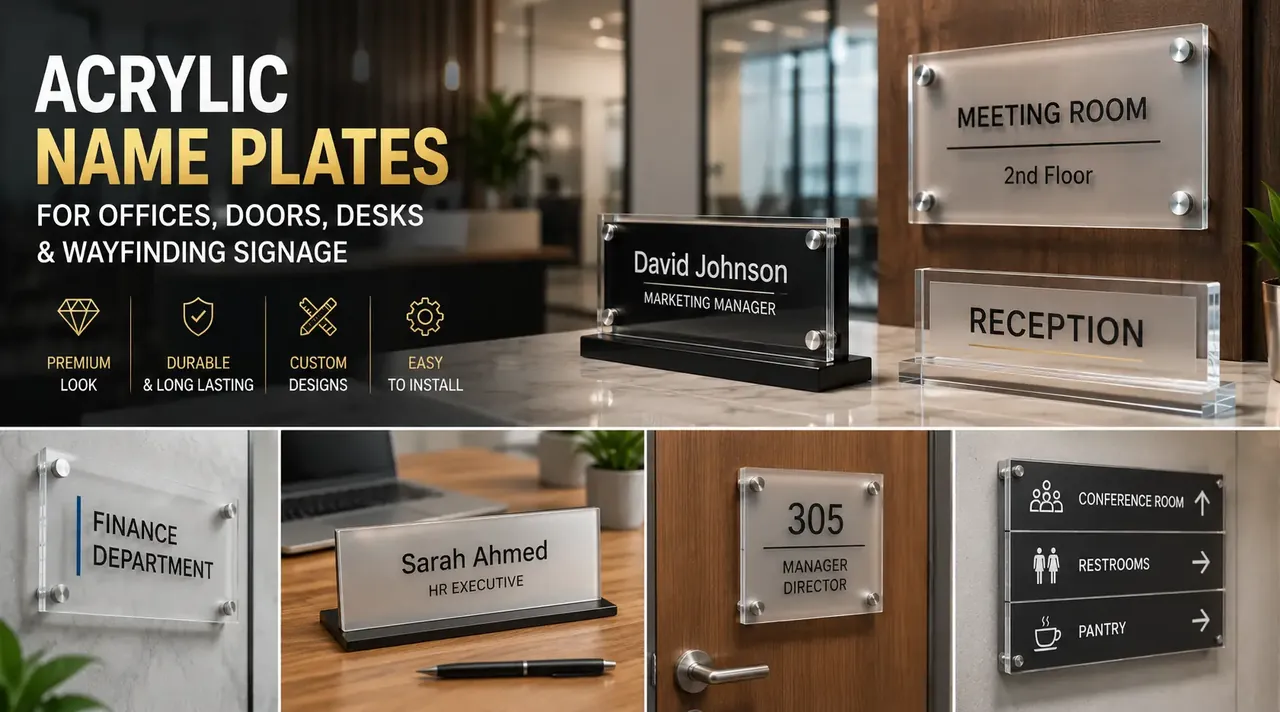
A practical Dubai office guide to choosing acrylic name plates for doors, desks, reception counters, meeting rooms, clinics, schools, and wayfinding systems.
Dubai focused Office door plates Desk name plates Bilingual layouts FAQ includedIf you are planning name plates for office doors, staff desks, reception areas, meeting rooms, clinics, schools, or directional signage in Dubai, this guide helps you choose the right acrylic finish, thickness, text method, and mounting style.
Acrylic name plates are small details, but they can change how an office, clinic, school, showroom, or reception area looks. In Dubai, where businesses often invest heavily in interiors, branding, and customer first impressions, name plates are not just labels. They guide visitors, identify rooms, support staff organization, and make a space look more professional.
If you are planning acrylic name plates Dubai offices can use for doors, desks, meeting rooms, cabins, reception areas, or wayfinding, this guide will help you make the right choices before placing an order. It covers material options, thickness, engraving, UV printing, mounting methods, bilingual layouts, design mistakes, and a practical checklist for ordering.
The goal is simple: your name plates should look clean, read clearly, match your office design, and stay fixed properly after daily use.
Why acrylic name plates are popular in Dubai offices
Acrylic name plates are widely used because they give a clean, modern look without making the space feel heavy. They work well in offices, clinics, real estate companies, government service centers, schools, retail offices, beauty clinics, co-working spaces, and corporate reception areas.
Dubai businesses often prefer acrylic because it can be customized in many ways. A name plate can be clear, frosted, colored, engraved, printed, layered, or mounted with standoffs. This gives design freedom without losing readability.
- Office door names
- Staff desk name plates
- Meeting room signs
- Reception wall identifiers
- Room number plates
- Department signs
- Directional signs
- Clinic room labels
- School and training room signs
- Bilingual English and Arabic name plates
For companies that want their interiors to look organized, acrylic gives a professional finish at a practical cost. It also connects well with wider office branding and acrylic signage in Dubai when a full office signage set is required.
Acrylic vs metal vs wood name plates
Acrylic name plates
Acrylic is the best choice when you want a modern and clean look. It works especially well in offices with glass partitions, white walls, wooden doors, marble counters, or modern reception interiors.
Acrylic is suitable for office door signage, desk plates, reception signs, meeting room signs, directional signage, and bilingual name plates. It can be clear, frosted, black, white, colored, or layered. It also supports engraving and UV printing.
Metal name plates
Metal name plates are often used when the interior has a luxury, industrial, or classic style. Brass, stainless steel, gold finish, and brushed metal plates can look premium, especially for executive rooms and formal office settings.
Metal works well for CEO cabins, director offices, high-end reception areas, and formal office doors. However, metal can be heavier and may not suit every modern office design.
Wood name plates
Wood name plates bring a warmer, natural look. They work well in interiors with wood panels, boutique offices, wellness spaces, and creative studios.
The main limitation is that wood may not match glass-heavy or ultra-modern office interiors as well as acrylic. For most Dubai offices, acrylic is the most flexible option because it supports clear branding, bilingual layouts, and bulk office signage sets.
Engraving vs UV printing vs vinyl lettering
The printing or marking method decides how your name plate looks and how long the text stays clear. Many buyers focus only on size, but the marking method is just as important.
Laser engraving
Laser engraving gives a permanent, professional result. It can be used for names, room numbers, logos, and simple icons. Engraving works especially well on clear, frosted, and colored acrylic.
It is a strong choice for premium door name plates, room numbers, reception signs, long-term office signage, and minimal corporate designs. For this type of work, see acrylic laser cutting and engraving in Dubai.
UV printing
UV printing is useful when your name plate needs colors, logos, gradients, or brand elements. It allows sharp graphics directly on acrylic and works well when you need the same design across many rooms or floors.
UV printing suits full-color company logos, department signs, branded reception plates, clinic signage, school signage, and directional signs with icons.
Vinyl lettering
Vinyl lettering is practical for temporary labels or budget-friendly updates. It can be used for short-term room names, event signage, and replaceable department labels. However, vinyl may not look as premium as engraving or UV printing for permanent office signage.
Choosing the right acrylic type and finish
Clear acrylic
Clear acrylic gives a glass-like look. It works well with printed or engraved text and is popular for glass cabins, reception counters, executive rooms, and premium desk name plates. Clear acrylic looks elegant, but fingerprints and dust can be more visible.
Frosted acrylic
Frosted acrylic gives a softer, more professional look. It reduces glare and often suits office doors, clinics, and meeting rooms. It is one of the safest choices when you want a clean, readable result.
Colored acrylic
Colored acrylic is useful when you want the name plate to match brand colors or interior themes. Make sure text contrast is strong. A beautiful color choice can fail if visitors cannot read it from a normal distance.
Layered acrylic
Layered acrylic combines two or more acrylic sheets. For example, a clear top layer over a colored back plate can create depth. It is suitable for premium reception plates, executive rooms, branded office sets, and high-end desk plates.
Layered designs need clean edges and accurate alignment. For this part of the work, see edge polishing and finishing in Dubai.
Thickness and size guidance for real office use
Acrylic thickness should match the size of the plate, mounting method, and how often the plate may be touched or cleaned.
3 mm acrylic
3 mm works for small name plates and simple door labels. It is lightweight and cost-effective, but it may not feel premium for larger plates.
5 mm acrylic
5 mm is a practical choice for many office door and desk name plates. It feels stronger and looks better from the side. For most Dubai offices, 5 mm is a strong starting point.
8 mm and above
Thicker acrylic gives a more premium look and better rigidity. It is used when the edge itself becomes part of the design, especially for executive desk plates, reception signs, layered acrylic name boards, and larger wall-mounted plates.
Practical rule: Small door labels can use 3 mm. Most permanent office plates are better in 5 mm. Premium desk and reception plates often look better in 8 mm or thicker.Readability rules for name plates
A name plate must look good, but it must also be easy to read. Many buyers choose fonts that look stylish on screen but become hard to read on an actual door or desk.
- Keep the font clean and simple
- Avoid very thin letters for small plates
- Use strong contrast between text and background
- Allow enough spacing between English and Arabic text
- Keep logos smaller than the main name or room title
- Check readability from the real viewing distance
For door plates, people often read while walking. For desk plates, people read from a closer distance. For reception signs, visitors may read from several meters away. Size your text based on the actual viewing situation.
Bilingual English and Arabic name plates
In Dubai, bilingual name plates are often required or preferred, especially for offices serving a mixed audience. English and Arabic can look excellent together when the layout is planned properly.
- Office door names
- Clinic room signs
- Government service counters
- Reception area labels
- School and training room signs
- Directional signs
Bilingual layout tips
- Do not squeeze Arabic text into leftover space
- Keep English and Arabic balanced visually
- Use fonts that are clear, not decorative
- Align text carefully so the plate does not feel crowded
- Confirm spelling and translation before production
The most common mistake is treating Arabic as a secondary line added at the end. A better approach is to design the plate as bilingual from the start.
Mounting options in Dubai sites
Adhesive mounting
Adhesive mounting is common for small and medium indoor name plates. It works well on smooth doors, glass, and flat walls. Avoid adhesive-only mounting for heavy plates, rough walls, dusty surfaces, or outdoor installations.
Standoff mounting
Standoff mounts give a premium floating effect. They are often used for reception signs and larger acrylic plates. Standoff mounts look better when the plate is thicker and the holes are finished cleanly.
Back panel mounting
Acrylic plates can be mounted on a back panel when the wall is uneven or when multiple signs need consistent alignment. This is useful for wayfinding systems, department signs, multi-room signage sets, and office floors with repeated layouts.
For repeated shape accuracy and clean cut-outs, see CNC routing in Dubai.
Office sets and wayfinding systems
Many Dubai offices need more than one name plate. They need a full signage set. This can include CEO room, manager cabins, meeting rooms, accounts department, HR department, pantry, washrooms, store room, reception, visitor direction signs, and floor number signs.
When producing a full set, consistency is more important than making each plate unique. Use the same thickness, corner radius, font style, mounting method, and spacing rules across all signs.
A consistent set makes the office look planned and professional.
Common mistakes buyers make
Choosing low contrast text
Gold text on clear acrylic may look premium in a mockup, but it can disappear on certain walls. Always check background color and lighting.
Selecting plates that are too thin
Thin plates may bend, feel cheap, or not sit well on standoffs. For permanent office signage, consider 5 mm or thicker.
Ignoring the mounting surface
Acrylic on smooth glass is different from acrylic on textured paint or wood veneer. The same adhesive will not work equally well everywhere.
Not planning Arabic spacing
Arabic text needs proper spacing and alignment. It should not look squeezed below the English text.
Approving without proofing names
Name plates often include personal names and room titles. A spelling mistake becomes expensive after production. Always approve a final proof.
Ordering checklist before production
- Final quantity
- Exact plate size
- Acrylic thickness
- Finish: clear, frosted, colored, layered
- Text details in English and Arabic
- Logo file in vector format if available
- Marking method: engraving, UV print, vinyl
- Mounting method: adhesive, standoff, back panel
- Corner style: sharp, rounded, bevelled
- Proof approval before production
- Packaging requirement for safe delivery
- Installation requirement if needed
Maintenance and cleaning tips
Acrylic name plates are easy to maintain when cleaned correctly. Use a soft microfiber cloth, mild soap solution, and gentle wiping pressure.
Avoid rough paper towels, abrasive sponges, strong solvents, scraping dust with dry cloth, and harsh chemical sprays. For offices with cleaners working daily, it is better to share care instructions. Most scratches happen because acrylic is wiped with rough cloths or cleaned with unsuitable chemicals.
External references: ASTM standards and materials testing references, ACRYLITE acrylic sheet care guidance, and UL plastics flammability testing overview.
Choosing the right acrylic name plate supplier in Dubai
A good supplier should do more than cut and print. They should guide you on thickness, finish, mounting, and layout.
- Do they understand office signage sets, not just one-off plates?
- Can they handle English and Arabic layouts neatly?
- Do they offer engraving and printing options?
- Can they suggest mounting based on your surface?
- Do they provide proof approval before production?
- Are edges finished cleanly and consistently?
- Can they pack the plates safely for delivery?
For a broader custom production approach, see acrylic fabrication company in Dubai.
Need acrylic name plates for your Dubai office?
Share your plate size, quantity, English and Arabic text, preferred finish, and mounting surface. We can suggest a practical thickness, layout, and production method.
Contact Acrylic Gallery PlusFrequently Asked Questions
What is the best thickness for acrylic name plates in Dubai offices?
For many office door and desk name plates, 5 mm is a practical choice. Smaller labels can use 3 mm, while premium reception or executive plates may use 8 mm or thicker.
Is engraving better than UV printing for door name plates?
Engraving is excellent for permanent, clean, minimal designs. UV printing is better when you need color logos, brand details, or full-color graphics.
Can we add Arabic and English on the same acrylic plate?
Yes. Bilingual acrylic name plates are common in Dubai. The layout should be planned carefully so English and Arabic both read clearly.
What mounting is best for glass, wood, or painted walls?
Smooth glass often works with adhesive mounting for lighter plates. Wood and painted walls may need stronger adhesive or standoff fixing depending on weight and surface condition.
Are acrylic name plates suitable outdoors in Dubai?
Acrylic can be used outdoors when the right grade, thickness, and fixing method are selected. Outdoor name plates need more care because of heat, dust, and UV exposure.
How do I clean acrylic name plates without scratches?
Use a microfiber cloth and mild soap solution. Avoid rough cloths, paper towels, abrasive sponges, and harsh chemical cleaners.
Can acrylic plates include logos and room numbers together?
Yes. Acrylic plates can include names, titles, logos, room numbers, icons, and bilingual text. UV printing is usually best for full-color logos.
What is a typical turnaround time for bulk office signage?
Turnaround depends on quantity, design approval, printing or engraving method, and installation needs. Bulk office sets should always include proof approval before production.
Conclusion
Acrylic name plates in Dubai are more than small labels. They help visitors move through your space, support a professional office image, and keep rooms, desks, and departments easy to identify. The best results come from choosing the right thickness, finish, layout, and mounting method before production begins.
For most modern offices, acrylic is a practical and premium-looking choice. It supports clear branding, bilingual layouts, and consistent signage sets across doors, desks, and reception areas. When planned properly, it gives your office a clean and organized look that lasts.