
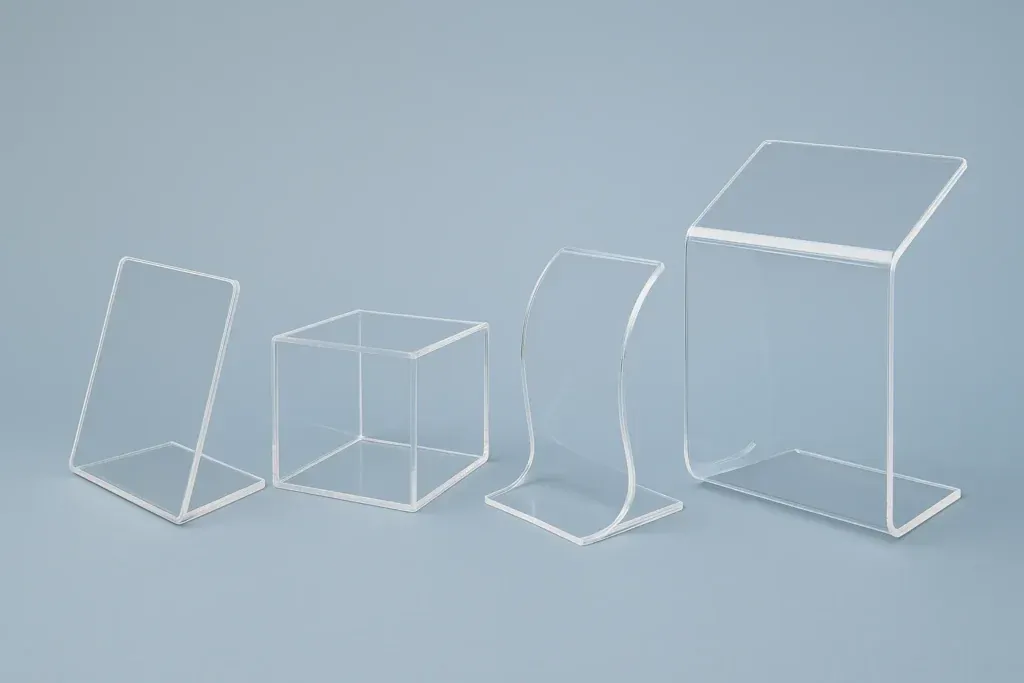
Made to your specification
Acrylic Bending in Dubai
Heat and line bending for acrylic stands, guards, shelves, covers, signage parts and custom formed components.
- Angles formed to drawing
- Single or repeat quantities
- Cutting and finishing available
MaterialAcrylic selected for the product and application
SizeCustom dimensions from your brief
FinishClear, coloured, polished or branded as specified
QuoteBased on drawings, quantity and finish
Commercial service
Bent and formed acrylic components
Heat and line bending for acrylic stands, guards, shelves, covers, signage parts and custom formed components.
A reference image helps, but it does not settle the build. The sheet type, thickness, bend angle, bend radius, leg lengths and finished tolerance determine whether a part can be formed cleanly.
Provide a dimensioned drawing, acrylic thickness, bend angle or radius, quantity, colour and a reference sample if one exists. That gives the team enough information to assess bend position, heat-forming method, spring-back allowance, edge finish and assembly with other parts without guessing.
What to include in your enquiry
- Dimensioned drawing or marked sketch
- Sheet thickness and colour
- Bend angle or radius
- Critical leg lengths and tolerances
- Quantity required
- Reference sample or photograph
- Required delivery date
Product scope
What we can bend and form
This service includes bent display stands, angled holders, and curved acrylic components. Most projects come from retail displays, countertop products, and office accessories, although the construction changes with each application.
Product types
- bent display stands
- angled holders
- curved acrylic components
- guards and shields
- shelves and risers
- signage parts
- furniture components
Where it is used
- retail displays
- countertop products
- office accessories
- signage
- custom protective covers
- interior features
Fabrication & finish
How acrylic bending is planned
Common workshop steps include controlled heat bending, line bending, and angle forming. Some projects use only one or two; others need several to work together.
- controlled heat bending
- line bending
- angle forming
- jig-assisted forming where needed
- trim and edge finishing
- assembly with other fabricated parts
Material and sizing decisions
Cast and extruded acrylic do not always behave the same way under heat. Thickness, colour and sheet quality can also affect the bend line, so the actual material should be agreed before a production batch is formed.
Mark finished sizes, openings and fixed reference points clearly. The workshop relies on them when reviewing bend position, heat-forming method, spring-back allowance, edge finish and assembly with other parts.
Finish after forming
A formed component may still need trimming, polished edges, drilling, bonding or printed branding. Mark visible faces and critical dimensions on the drawing so finishing is applied in the right places.
How it works
From drawing to formed component
The team first checks bend position, heat-forming method, spring-back allowance, edge finish and assembly with other parts. Once those points are clear, the material, finish and production route can be agreed without building assumptions into the quotation.
Share
Send a dimensioned drawing, acrylic thickness, bend angle or radius, quantity, colour and a reference sample if one exists.
Review
The team checks bend position, heat-forming method, spring-back allowance, edge finish and assembly with other parts.
Confirm
Before work starts, the team confirms the drawing and commercial scope, including part size, material thickness, number of bends, jig requirements, quantity and finishing. Price and the expected handover date are recorded with the approval.
Fabricate
Once approved, the job moves into the workshop. The final check returns to bend position, heat-forming method, spring-back allowance, edge finish and assembly with other parts before collection, delivery or installation.
Dubai & UAE enquiries
Timing and delivery
Production timing depends on part size, material thickness, number of bends, jig requirements, quantity and finishing. A workable date is confirmed after the drawing and scope are approved.
For delivery, mention whether the parts must be nested, protected individually or supplied as part of a larger assembly. This avoids last-minute problems after the item is finished.
Frequently asked questions
Can you bend acrylic to a custom angle?
Custom angles and formed shapes can be reviewed from a drawing, sample or reference image.
Can thick acrylic be bent?
Feasibility depends on sheet type, thickness, bend radius and part size. These details should be reviewed before production.
Can bending be combined with laser cutting?
A fabricated part may use more than one process, such as cutting, bending and assembly, when the design calls for it.
Related capabilities
Other services that may connect to your project
Service
Edge Polishing & Finishing
Acrylic edge polishing and finishing in Dubai for panels, displays, signs, furniture parts and fabricated components.
View service →ServiceExhibition Stands
Custom acrylic display components and stand elements in Dubai for exhibitions, trade shows, launches and brand activations.
View service →ServiceAcrylic Fabrication
Custom acrylic fabrication in Dubai for retail displays, branded products, boxes, signs, furniture and made-to-order parts.
View service →ServiceAcrylic Display Stands
Custom acrylic display stands in Dubai for retail counters, perfume, cosmetics, electronics, launches and exhibitions.
View service →Related guidance
Guides related to bent and formed acrylic components
The articles below go deeper into material, measurement and ordering decisions that often come up with bent and formed acrylic components.
Have a part that needs bending or forming?
Send a dimensioned drawing, acrylic thickness, bend angle or radius, quantity, colour and a reference sample if one exists. That gives the team enough detail to check the build and identify anything missing before quotation.