
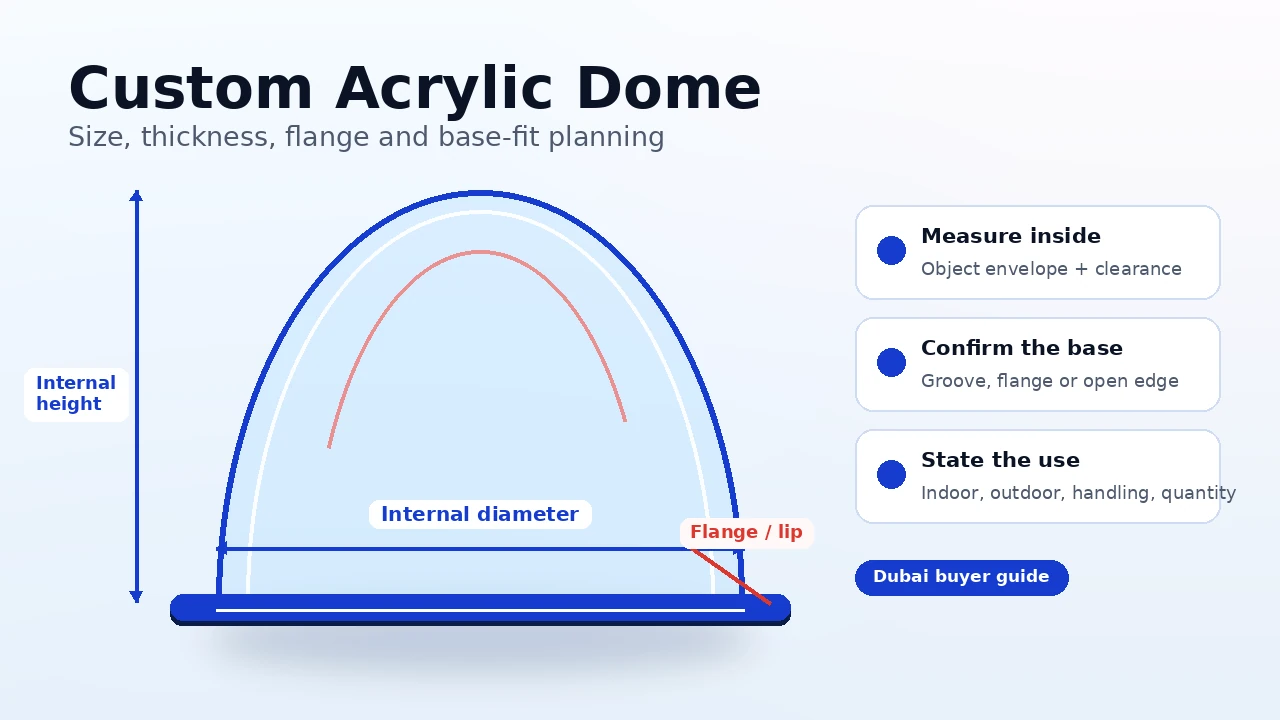
A photograph of the object is useful, but it is not enough to price a custom acrylic dome. The workshop still needs measurements. Two covers can share the same diameter but still need different material, tooling and trim work. One may be shallow and supported by a base. The other may be tall, lifted every day and fixed through a flange.
The scope here is retail displays, model covers, product presentation, exhibition pieces, dust covers and similar non-pressurised work. Pressure vessels, certified machine guards, structural glazing, medical equipment and other regulated uses need their own engineering or testing route.
The measurements that matter before anyone talks about tooling
| Specification point | What to provide | Why it matters |
|---|---|---|
| Object envelope | Maximum width, depth and height of the item being covered | Sets the minimum clear space inside the dome. |
| Internal opening | Required inside diameter, or inside width and depth for a non-round cover | Outside measurements can hide the real clearance available. |
| Internal height | Clear height from the seating surface to the inside crown | Object height and dome height are not the same once the base and clearance are included. |
| Bottom edge | Open trimmed edge, outward flange, return lip, groove fit or another connection | Changes tooling, trim, support and how the cover is secured. |
| Base | Drawing, groove dimensions, rebate, fixing method and material | The dome and base must be designed as one assembly. |
| Use conditions | Indoor or outdoor, lighting, heat sources, handling, cleaning and access | Affects grade, support, ventilation and care instructions. |
| Quantity | Prototype, one-off piece or repeat batch | Tooling and process planning change with quantity and repeatability. |
| Visual standard | Normal display clarity, close inspection, photography or low-distortion viewing | A formed cover is not automatically an optical lens. |
Start with internal clearance, not outside diameter
Customers often measure the visible object and ask for a dome with the same diameter. That leaves no room for the object to pass through the opening, no tolerance for a base, and no space for handling. Measure the largest part of the object first. Then add the working clearance needed to place, remove and clean it.
Use the internal dimensions on the enquiry. If the object is not round, record its maximum width and depth in the orientation it will sit. A round dome can still cover a rectangular product, but its internal diameter must clear the object’s diagonal or another agreed envelope.
Height needs the same care. Measure from the final seating surface, not from the bottom of the object before the base is designed. Include plinths, labels, cable exits, raised mounts and any part that sits above the product.
Seven dimensions that prevent fit problems
1. Maximum object width and depth
Measure the object at its widest points. Do not rely on a catalogue size if handles, packaging, display mounts or cables extend beyond it. For an irregular shape, a top-view sketch with marked extremes is more useful than one overall number.
2. Maximum object height
Include the plinth, stand, label and anything else that will remain under the cover. If the item needs to be lifted out while the dome stays in place, explain the access method.
3. Internal diameter or internal width and depth
For a round cover, state the clear inside diameter at the opening. For an oval or another formed shape, supply both axes or a dimensioned drawing. Avoid asking for an “approximately 500 mm dome” when fit is important.
4. Internal rise
The internal rise is the clear height from the seating surface to the inside crown. A shallow cap and a near-hemisphere with the same opening diameter form differently, so the rise belongs on the drawing.
5. Flange width and direction
State whether the flange extends outward, turns inward, sits flat on a base or drops into a groove. Mark its clear width and any fixing holes. A flange that looks small in a reference image can become a critical structural and installation detail.
6. Base groove, rebate or locating ring
If a base is already built, provide the actual groove width, depth and diameter. If the base is being made with the dome, confirm its material, finish and how the cover should be removed. A loose display cover and a fixed outdoor enclosure need different details.
7. Openings and cut-outs
Mark cable holes, ventilation slots, access openings, locks and fasteners. Cutting after forming may be possible, but every opening affects trim, support and stress around the edge. Put them on the drawing before quotation.
Dome shape changes more than appearance
The word “dome” can describe several forms. A shallow spherical cap gives a low profile. Taller forms create more headroom. Near-hemispherical shapes have a different draw and visual effect. An oval or rectangular curved cover may need another mould concept altogether.
Do not choose shape only from a front photograph. State what people need to see, the viewing height, the surrounding furniture and how the cover will be lifted. A very tall crown can add volume without improving visibility. A shallow form can look neat but may leave poor clearance over the object.
If the project must match an existing dome, send the sample where practical, along with the base and the dimensions that matter. Copying a shape from a photograph alone is unreliable because lens perspective hides the true rise and edge detail.
How acrylic dome thickness is selected
There is no responsible thickness answer based only on diameter. The starting sheet is chosen after considering the opening size, rise, shape, expected thinning during forming, handling, bottom support, openings, visual standard, use location and quantity.
For example, two domes may both have a 600 mm opening. One is a shallow indoor dust cover seated continuously in a base. The other is tall, frequently removed and fixed through a flange. They do not place the same demand on the sheet or edge.
The exact acrylic grade matters as well. Röhm lists cast and extruded PLEXIGLAS sheet in a wide range of thicknesses and describes both as processable by forming. That does not mean every grade, colour and thickness will behave identically. The supplier’s product data and the fabricator’s process must match the job.
Starting sheet is not finished wall thickness
Thermoforming changes the sheet as it is drawn over or into a mould. The wall does not remain identical at every point. Deeper shapes and steeper transitions require more attention to material distribution. For this reason, a quotation should identify the starting sheet and the approved form rather than promising that every part of a deep dome will equal the starting thickness.
If minimum finished thickness is critical, state it as a performance requirement and ask how it will be checked. This matters more for frequently handled covers, large openings, mounted parts and any application where failure could create a safety risk.
Heating and cooling affect the result
Manufacturer guidance for PLEXIGLAS describes heating the sheet, forming it on a prepared mould and allowing it to cool slowly. It also notes that thicker sheet takes longer to heat and may need attention to even heating. These are process controls, not a home-use recipe for a finished commercial dome.
Clean handling matters too. Dust, tool marks and mould defects can transfer into a visible clear part. A buyer should agree the important viewing area and finish standard before production, especially for close-up product displays or photography.
Flange, lip, groove or open edge?
The bottom edge decides how the dome sits, seals, lifts and survives handling. It should be chosen with the base, not added as an afterthought.
| Bottom detail | Where it can help | Points to confirm |
|---|---|---|
| Trimmed open edge | Loose covers that sit over a plinth or locating ring | Edge finish, fit clearance, lifting points and protection from chipping. |
| Outward flange | Fixing, clamping or spreading load over a base | Flange width, flatness, hole position, gasket and fastener pressure. |
| Return lip | Locating the cover around or inside a base detail | Release from tooling, fit tolerance and whether the lip remains visible. |
| Groove fit | Displays that need a neat base connection without visible fixings | Groove width, depth, insertion clearance and how the dome is removed. |
| Bonded or fixed assembly | Enclosures that should not be lifted by visitors | Access, cleaning, ventilation, serviceability and compatible joining methods. |
Fasteners should not be treated like screws into metal. Hole size, edge distance, washer or gasket, tightening force and thermal movement need review. If the cover must be locked, explain whether access is occasional or frequent so the base and hardware can be planned around real use.
Clarity, reflections and optical distortion
Clear acrylic is chosen because it lets the object remain visible, but a formed surface changes reflections and can bend the view. A display dome is not automatically suitable for measurement, imaging, magnification or other optical work.
Tell the fabricator where people will stand and what they need to see. A museum-style display viewed from several angles has a different requirement from a protective cover over a machine indicator. If low distortion is important, agree a sample, viewing zone or acceptance method before the full order.
Colour and finish should be named as well. Clear, tinted, frosted, translucent and opaque acrylic produce very different results. For lighting work, describe the light source, colour, heat and distance from the sheet. Do not assume a display-grade clear dome will also work as a light diffuser.
Indoor and outdoor use in the UAE
Outdoor use needs the exact sheet grade, not the word “acrylic” on its own. Röhm describes PLEXIGLAS GS and XT as naturally UV-stable and weatherproof, and it publishes separate guidance on temperature behaviour and expansion. Those statements apply to the named products. Ask for the data sheet for the material actually being supplied.
In the UAE, direct sun, dark bases, enclosed air and nearby lighting can raise the temperature around the object. A dome can also trap heat. Electronics, plants, food, wax products and heat-sensitive exhibits may need ventilation or another cover design. A fabricator can provide openings, but the required airflow should come from the project designer or equipment supplier.
Outdoor mounting should consider wind, drainage, dust, cleaning, expansion and how the cover is restrained. A loose indoor display dome should not be moved outside without a fresh review.
Base design and daily handling
The base controls more than appearance. It locates the dome, protects the edge and gives staff a safe way to remove or secure it. Send the base drawing with the dome enquiry, even when another contractor is making the base.
Explain who will handle the cover and how often. A small counter cover may be lifted by one person. A wide dome can be awkward even when acrylic is lighter than glass. Handholds, removable panels or a different enclosure layout may be safer than lifting the full cover.
Packing also deserves attention. A formed surface can be scratched during transport if it rubs against hard material. Confirm delivery location, access, final assembly and whether protective wrapping must remain until installation.
Openings, ventilation and access
Access holes, cable slots and ventilation should be drawn before the mould and trim plan are finalised. Place cut-outs away from highly stressed transitions where possible. Rounded corners and suitable edge finishing can reduce stress concentration compared with sharp internal corners.
If the dome covers equipment, do not use ventilation holes as a guess. Confirm the heat load and required open area with the equipment manufacturer or project engineer. The acrylic fabricator can then review a practical pattern and production method.
For retail displays, access may be simpler: a lift-off cover, removable base panel or lockable hatch. The correct choice depends on product replacement, theft control, dust protection and cleaning.
One-off dome or repeat production?
A one-off cover may be possible, but forming normally requires a mould or controlled forming tool. That tool has a cost whether the order is one piece or a batch. For repeat work, a more durable tool and a documented trim method can improve consistency.
State the full expected quantity, not only the first sample. If the project starts with one approval piece followed by 20 units, say so. The workshop can then plan tooling and production around the real requirement instead of pricing the sample as an isolated job.
For exact replacement work, keep the approved drawing, material reference and base dimensions. A photograph of the first unit is useful, but it is not a controlled specification for later orders.
What affects acrylic dome price?
- Overall opening size and forming height
- Starting sheet grade, colour and thickness
- Mould design and tooling material
- Forming depth and shape complexity
- Flange, return lip, trim and edge work
- Holes, slots, hardware and ventilation
- Base fabrication or coordination with another supplier
- Prototype, sample approval and repeat quantity
- Optical and cosmetic acceptance standard
- Packing, transport, access and installation support
A quick price based on diameter alone can exclude the work that makes the dome fit. A marked drawing usually produces a more useful quotation than a message asking for “one clear dome, medium size.”
From drawing to finished dome
- Brief review: confirm the object, use, internal dimensions, base, quantity and visual requirement.
- Drawing: record the opening, rise, flange, trim, holes and tolerances.
- Material and tooling: select a suitable sheet and plan the mould or forming tool.
- Forming: heat the sheet using a controlled process and form it to the approved geometry.
- Cooling and trim: allow the part to stabilise, then trim the edge and complete openings or finishing.
- Trial fit: check the base connection, clearances, appearance and handling.
- Approval and repeat work: record the accepted drawing and relevant production details for the order.
The sequence can change by project. A large or close-tolerance dome may need a prototype or sample before the final quantity is released.
Common specification mistakes
- Giving only outside diameter. The fabricator needs the clear space inside the cover.
- Making dome height equal to object height. The base, clearance and formed crown reduce usable space.
- Choosing thickness from a generic chart. Shape, rise, support and handling can change the requirement.
- Leaving the flange undefined. A flange affects tooling, trim and base design.
- Sending no base information. The dome cannot fit a groove or rebate that has not been measured.
- Ignoring the final use. Indoor display, outdoor exposure, lighting and frequent lifting are different conditions.
- Expecting lens-level optics. State the viewing requirement and approve a sample if distortion matters.
- Hiding the repeat quantity. Tooling for one trial piece may not be the best choice for a production batch.
Acrylic dome quotation checklist
Send the following in one message or drawing:
- Object maximum width, depth and height
- Required internal opening and internal rise
- Working clearance around and above the object
- Dome shape or a marked reference image
- Flange, lip, open edge or groove-fit detail
- Base drawing and material
- Clear, tinted, frosted or another appearance
- Indoor, covered outdoor or fully exposed location
- Lighting, electronics or heat sources under the cover
- Holes, cable exits, ventilation and access requirements
- Quantity now and likely repeat quantity
- Delivery location and installation access
- Any required material certificate or regulated performance
A dimensioned PDF, CAD drawing or clear hand sketch can all work for an initial review. Mark which dimensions are fixed and which can change. When the base already exists, include close photographs with a ruler or calliper reading beside the groove.
Technical sources checked
These manufacturer pages support the general forming, grade and outdoor-use points in this guide. They do not replace the data sheet for the exact acrylic sheet selected for a project.
- Acrylic sheet bending and forming — PLEXIGLAS
- Cast and extruded acrylic product information — PLEXIGLAS
- Temperature behaviour and expansion guidance — PLEXIGLAS
- UV-resistance information — PLEXIGLAS
Questions that come up when ordering a dome
Can an acrylic dome be made to any size?
Not every size and shape is practical in every sheet or process. Feasibility depends on the opening, rise, grade, starting thickness, tooling, trim and equipment available. Send a drawing for review before fixing the design.
How do I choose acrylic dome thickness?
Do not choose it from diameter alone. The fabricator should review dome depth, material distribution, support, handling, openings, location and the required finished performance before selecting a starting sheet.
Does every dome need a flange?
No. A dome can have a trimmed open edge, outward flange, return lip, groove fit or another base connection. The base and the way the cover is secured decide which detail is useful.
Can the base be made with the dome?
Base fabrication can be included in the project brief. Provide the desired material, finish, overall size, groove or locating detail, access method and any locks or fixings.
Can a clear acrylic dome be used outdoors in Dubai?
It may be possible with a suitable grade and mounting design. The exact sheet, sun exposure, heat build-up, wind, drainage, expansion, fixing and expected service conditions all need review.
Will a formed dome have perfect optical clarity?
A clear dome can provide good product visibility, but forming changes reflections and can introduce optical distortion. If low distortion is critical, define the viewing area and agree a sample or acceptance method.
Can you copy an existing dome?
An existing sample can help, especially with the base. It should still be measured and converted into an approved drawing. A photograph alone does not show the true internal rise, edge or flange detail.
Is a one-off dome possible?
One-off work may be possible, but mould and setup work still apply. Tell the fabricator whether a later batch is expected so the tooling plan can suit the full requirement.
A good dome enquiry can fit on one marked sketch
Once the object and base are settled, the brief becomes quite compact: mark the clear internal opening, internal rise, flange or edge detail, any holes, quantity and use location. Add a simple side view when the shape is not obvious.
Production questions can go to the custom acrylic domes service page. For formed parts, the acrylic bending page explains the related process; broader one-off builds sit under custom acrylic fabrication in Dubai.
Ready to turn the measurements into a dome brief?
Attach the marked drawing and one photo showing the object on its intended base. That tells the workshop far more than a reference image on its own.