
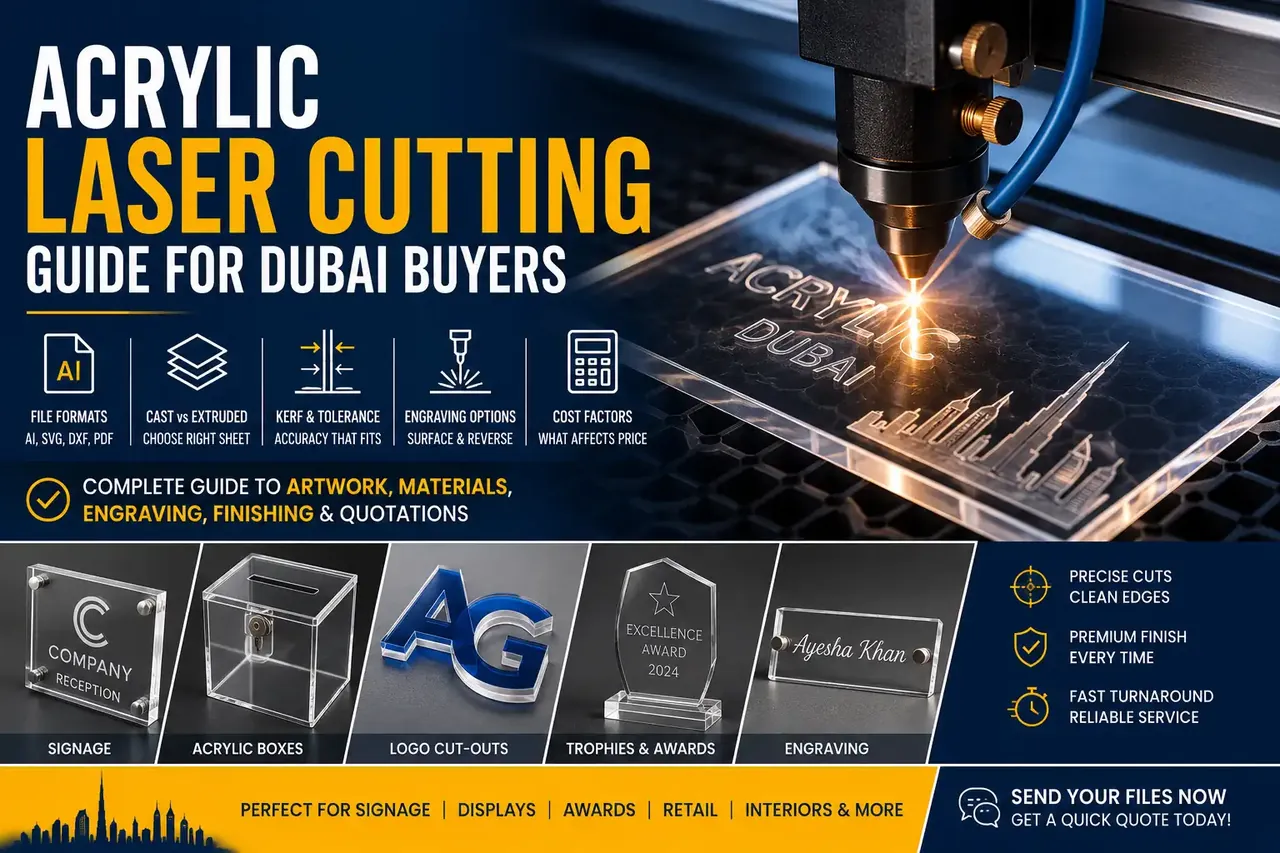
A practical guide for Dubai businesses preparing acrylic signs, display parts, boxes, awards, lettering, engraved panels and custom components.
Acrylic laser cutting can produce clean letters, logo shapes, display parts, engraved panels and detailed components. However, the machine alone does not guarantee a good result. The acrylic grade, sheet thickness, artwork quality, cut-line setup and intended use all affect the finished piece.
A blurry logo, duplicate vector lines or an incorrect slot size can cause problems before production even starts. Likewise, the wrong acrylic type may give a different engraving finish from the one the buyer expected.
This acrylic laser cutting guide for Dubai buyers explains the practical details that matter before placing an order. It is useful for signage companies, retailers, interior designers, event teams, architects, product brands and businesses that need custom acrylic parts.
For project quotations and direct production enquiries, visit the dedicated acrylic laser cutting and engraving in Dubai service page.
What Is Acrylic Laser Cutting?
A laser cutter follows digital artwork and directs a focused beam across the acrylic sheet. The beam heats the material along the selected path and cuts through it without a physical blade touching the surface.
Because the process follows computer-controlled artwork, it suits detailed shapes, repeat components, lettering and customised outlines.
Businesses commonly use laser-cut acrylic for:
- Shop and office signs
- Display stands
- Name plates
- Product risers
- Boxes and covers
- Trophies
- Menu holders
- Logo cut-outs
- Directional signs
- Event branding
- Templates and small components
The same machine may also engrave the acrylic surface. Therefore, one project can include a cut outer shape, engraved text and small internal holes.
Still, every design needs a production review. Very thin sections, tiny holes and narrow bridges may not cut reliably at the final size.
Laser Cutting, Engraving and Surface Marking
Buyers often use the words cutting and engraving together. However, they describe different processes.
Laser Cutting
Laser cutting passes fully through the acrylic sheet. It creates the outside shape and any internal openings.
Fabricators use it for:
- Letters
- Logo shapes
- Slots
- Holes
- Panels
- Box components
- Decorative patterns
- Custom product outlines
Laser Engraving
Engraving removes material from the acrylic surface without cutting through the sheet.
It works well for:
- Names
- Dates
- Company logos
- Award categories
- Instructions
- Identification numbers
- Decorative patterns
The final engraving appearance depends on the acrylic type, colour and surface finish.
Reverse Engraving
Reverse engraving places the design on the rear of clear acrylic. As a result, the front remains smooth and easy to clean.
This method often suits:
- Reception signs
- Name plates
- Directional panels
- Awards
- Clear branded displays
The artwork usually needs mirroring before engraving. Epilog’s official acrylic laser-cutting and engraving guidance also explains the use of mirrored artwork for rear-surface engraving.
Acrylic Laser Cutting vs CNC Routing
Laser cutting and CNC routing both shape acrylic, but they solve different production needs.
Choose Laser Cutting for Detailed Work
Laser cutting often suits:
- Small lettering
- Fine internal shapes
- Detailed logos
- Engraved text
- Thin and medium acrylic parts
- Decorative panels
- Repeat flat components
The process can also leave a smooth, glossy edge on suitable acrylic when the material and settings match the job.
Choose CNC Routing for Larger or Mechanical Parts
CNC routing may work better for:
- Thick sheets
- Large panels
- Deep grooves
- Pockets
- Rebates
- Mechanical fittings
- Structural parts
- Selected close-tolerance components
The rotating cutting tool physically removes material. Therefore, the edge usually needs a different finishing process from a laser-cut edge.
Some Projects Need Both Methods
A display unit may use CNC-routed base panels and laser-cut logo details. Likewise, a large sign may need routed support parts with engraved acrylic faces.
For large sheets, grooves, slots and thicker components, CNC routing in Dubai may provide a more suitable production route.
Cast vs Extruded Acrylic for Laser Processing
Cast and extruded acrylic can look similar before production. However, they may react differently during engraving and cutting.
Cast Acrylic
Cast acrylic often gives strong engraving contrast. The engraved area may develop a frosted appearance that works well for logos, awards and premium display pieces.
Buyers often choose cast acrylic for:
- Detailed engraving
- Trophies
- Branded plaques
- Reception signs
- Decorative panels
- Premium displays
However, cast sheets may have slight thickness variation. This point matters when the design includes tight slots, press-fit joints or interlocking components.
Extruded Acrylic
Extruded acrylic generally offers more consistent sheet thickness. Therefore, it can suit repeated parts where the design depends on predictable material dimensions.
Common applications include:
- Standard display components
- Repeated flat parts
- Boxes
- Covers
- General signage pieces
- Production quantities
Its engraved appearance may differ from cast acrylic. For that reason, buyers should approve a sample when engraving quality plays a major role.
Trotec’s official acrylic processing guide discusses the different cutting and engraving behaviour of cast and extruded acrylic sheets.
Which Acrylic Should You Select?
Choose the material according to:
- Required engraving contrast
- Sheet-thickness consistency
- Final product appearance
- Slot and fitting requirements
- Order quantity
- Budget
- Intended use
Instead of choosing only by price, explain the final application to the fabricator. A trophy face, a box panel and an interlocking component may need different sheet properties.
Preparing Artwork for Acrylic Laser Cutting
Good artwork saves time and reduces production errors.
Supply Vector Cut Lines
Vector artwork defines a clean path for the machine. Common file formats include:
- AI
- EPS
- SVG
- DXF
- Vector PDF
Before sending the file, confirm that the workshop supports the selected format.
A screenshot, low-resolution JPG or WhatsApp image may help as a visual reference. However, it should not replace proper production artwork.
Convert Fonts to Outlines
The workshop may not have the font used in the original design. If the file opens with a missing font, the software may replace it and alter the approved lettering.
Converting fonts to outlines preserves the letter shapes.
This step matters for:
- Brand names
- Arabic text
- Custom fonts
- Award titles
- Technical labels
Check every spelling before converting the text. After conversion, editing becomes less convenient.
Separate Cutting and Engraving Layers
Keep each production process on a clearly named layer.
For example:
- Through cut
- Surface engraving
- Light marking
- Print reference
- Fold or bend guide
Also remove duplicate lines. If two identical paths sit on top of each other, the laser may repeat the cut and apply unnecessary heat.
Include Final Dimensions
State the final measurements in millimetres. Also clarify whether the dimensions refer to:
- Overall outside size
- Internal opening
- Slot width
- Hole diameter
- Finished assembled size
Do not ask the workshop to estimate the scale from a photograph.
Use Strong Source Images for Photo Engraving
Photo engraving needs a clear, high-resolution image with suitable contrast. Compressed images may lose facial details, textures and fine edges.
For bulk orders, request one test piece before approving the complete quantity.
Understanding Laser Kerf
Kerf is the narrow line of material that the laser removes while cutting.
Although the line may look very small, it affects parts that must fit together. For example, a slot designed at exactly the same width as the acrylic thickness may become too loose or too tight after cutting.
Kerf can change according to:
- Acrylic type
- Sheet thickness
- Laser power
- Cutting speed
- Lens
- Focus
- Machine condition
- Material colour
Therefore, one kerf value does not suit every machine and material.
Projects that need accurate fitting should include a test piece. This applies especially to:
- Interlocking boxes
- Press-fit stands
- Slot-and-tab displays
- Layered signs
- Acrylic furniture parts
- Assembly jigs
Practical advice: approve a small fitting sample before bulk production. A simple kerf test can prevent loose joints, cracked slots and wasted sheets.
Minimum Details, Gaps and Fragile Shapes
A design that looks clear on a large computer screen may become fragile at its actual size.
Very thin sections can break during cutting, cleaning or installation. Likewise, small internal gaps may melt together when they sit too close.
Review these details before production:
- Thin letter strokes
- Narrow bridges
- Small holes
- Sharp internal corners
- Unsupported decorative lines
- Tiny engraved text
- Long flexible sections
Rounded internal corners may also improve strength in selected parts.
Arabic Lettering Needs Careful Review
Arabic logos and words can include dots, fine connections and separate character details. At a small size, those elements may become difficult to cut or install.
The designer may need to:
- Increase thin strokes
- Support isolated dots
- Join selected parts
- Add a clear backing panel
- Use engraving instead of separate cut pieces
- Increase the overall size
Always review Arabic artwork at the final production dimensions.
Choosing Acrylic Thickness
No single thickness works for every laser-cut product.
A small name plate and a large display shelf face different loads. Therefore, thickness selection should consider the actual application.
Important factors include:
- Overall product size
- Unsupported span
- Product weight
- Wall or counter fixing
- Indoor or outdoor use
- Need for bending
- Need for bonding
- Required edge appearance
- Slot design
- Handling frequency
Thin acrylic can suit lightweight signs, labels and small display parts. Meanwhile, thicker sheets may suit larger signs, premium awards, strong bases and rigid panels.
However, increasing thickness also affects cost, weight, cutting time and fitting details.
Clear, Frosted, Coloured and Mirror Acrylic
Clear Acrylic
Clear sheets suit:
- Protective covers
- Display cases
- Boxes
- Brochure holders
- Reverse-engraved signs
- Product displays
Clear acrylic keeps the surrounding products visible and works well with engraved or printed branding.
Frosted Acrylic
Frosted sheets reduce full transparency and create a softer appearance.
Businesses often use them for:
- Premium office signs
- Privacy panels
- Reception branding
- Decorative inserts
- Diffused lighting details
Coloured Acrylic
Coloured acrylic can match brand themes or separate product categories.
It works well for:
- Layered logos
- Display bases
- Lettering
- Decorative panels
- Retail fixtures
- Event branding
Mirror Acrylic
Mirror acrylic adds a reflective finish without the weight of glass mirror.
Common uses include:
- Event lettering
- Decorative signs
- Retail displays
- Wedding details
- Premium product branding
However, the reflective face needs careful handling and protective packing.
Edge Quality After Laser Cutting
Laser cutting can leave a smooth, glossy edge on suitable acrylic. Still, the result depends on the material, thickness and machine setup.
A clean edge needs:
- Suitable cutting speed
- Correct focus
- Stable material
- Proper air control
- Clean sheet surfaces
- Appropriate power settings
Protective film can reduce handling marks. However, the workshop may remove or replace it depending on the cutting and engraving process.
Some projects still need extra finishing. For example, visible thick edges, routed parts or bonded surfaces may require further preparation.
For selected high-visibility components, edge polishing and finishing in Dubai can improve the final appearance.
Products Made with Laser-Cut Acrylic
Signs and Office Branding
Laser cutting supports:
- Reception logos
- Door signs
- Directional panels
- Department signs
- Desk name plates
- Wall lettering
Retail and Hospitality Displays
Retailers, hotels and restaurants use laser-cut acrylic for:
- Product risers
- Price holders
- Menu stands
- Shelf branding
- Tester trays
- QR-code stands
Boxes and Covers
The process can create panels for:
- Donation boxes
- Suggestion boxes
- Display cases
- Protective covers
- Equipment enclosures
- Collection boxes
Awards and Event Products
Laser cutting and engraving suit:
- Trophies
- Plaques
- Name tags
- Table signs
- Speaker gifts
- Branded event pieces
Prototypes and Repeat Parts
Businesses may also order:
- Templates
- Spacers
- Control panels
- Custom inserts
- Numbered components
- Repeat product parts
An acrylic fabrication company in Dubai can combine cutting with bending, bonding, printing and assembly when the project needs more than flat parts.
Engraving and Branding Options
Laser engraving can work alone or alongside other branding methods.
Common options include:
- Frosted surface engraving
- Reverse engraving
- Filled engraving
- UV printing over acrylic
- Layered coloured acrylic
- Edge-lit engraved panels
- Serial numbers
- Personalised names
For example, a trophy may use a laser-cut outline, an engraved recipient name and a UV-printed company logo. Similarly, a reception sign may combine reverse engraving with a coloured backing layer.
The best method depends on viewing distance, colour requirements and handling.
Common Problems and Their Causes
Melted Fine Details
Small gaps and narrow strokes may receive too much heat. Increasing the detail size or changing the production method can improve the result.
Inconsistent Engraving
Mixed sheet types, coatings or surface conditions can create different engraving shades. Use material from the same confirmed specification for repeat orders.
Marks on the Back Surface
Machine-bed reflection or poor support can mark the underside. The workshop should choose the correct support and masking method.
Loose or Tight Slots
The artwork may not account for kerf or actual sheet thickness. Therefore, test the fit before bulk production.
Scratched Finished Parts
Acrylic scratches when workers stack or transport it without protection. Keep protective film in place where possible and separate finished pieces during packing.
What Affects Acrylic Laser-Cutting Cost in Dubai?
The price depends on the complete production scope.
Main cost factors include:
- Acrylic type
- Sheet thickness
- Material colour
- Overall dimensions
- Total cutting length
- Number of internal details
- Engraving area
- Order quantity
- Artwork preparation
- Prototype requirement
- Sorting and labelling
- Edge finishing
- Bonding or assembly
- Urgent production
- Packaging and delivery
Two pieces with the same outside size may have different prices. A plain rectangle takes less cutting time than a detailed logo with several internal openings and engraved text.
Likewise, a complete box costs more than a set of flat panels because the project may also require bonding, hinges, locks or assembly.
Acrylic Laser-Cutting Quotation Checklist
Before requesting a quotation, prepare:
- Final dimensions
- Required quantity
- Acrylic colour
- Sheet thickness
- Cast or extruded preference, when known
- Cut artwork
- Engraving artwork
- Vector logo
- Intended use
- Slot or fitting requirements
- Indoor or outdoor location
- Edge-finish requirement
- Assembly requirement
- Delivery date
- Reference photograph
- Sample requirement
Clear information helps the workshop recommend a suitable material and production process.
For a direct quotation, send these details through the custom laser-cut acrylic in Dubai service page.
Why a Prototype Matters
A prototype costs less than correcting a complete order.
One sample can confirm:
- Final size
- Slot fit
- Engraving contrast
- Letter strength
- Hole positions
- Layer alignment
- Product stability
- Branding appearance
A sample becomes especially important for interlocking parts, detailed Arabic lettering, custom boxes and bulk personalised products.
After approval, the workshop can repeat the confirmed design with fewer surprises.
Need Laser-Cut or Engraved Acrylic in Dubai?
Share the final size, quantity, acrylic colour, thickness, vector artwork and intended use. Acrylic Gallery Plus can help with custom cutting, engraving, branding, finishing and assembly.
View Acrylic Laser Cutting ServicesFrequently Asked Questions
What file format is best for acrylic laser cutting?
Vector formats such as AI, EPS, SVG, DXF and vector PDF usually work best. Confirm the accepted file format with the workshop before submitting the artwork.
Is cast or extruded acrylic better for laser engraving?
Cast acrylic often gives stronger frosted engraving contrast. Extruded acrylic can offer more consistent sheet thickness. The correct choice depends on the required finish and fitting tolerance.
What is laser-cutting kerf?
Kerf is the narrow line of material removed by the laser. It can affect slot sizes, interlocking parts and press-fit assemblies.
Can a laser cut thick acrylic?
Laser machines can process several acrylic thicknesses, but the practical limit depends on the machine, material and required edge quality. Ask the fabricator to review the exact specification.
Can Arabic letters be laser cut accurately?
Yes, provided the strokes, dots and gaps remain large enough at the final production size. Very small character details may need support, enlargement or engraving.
Why do small acrylic details melt or break?
Thin sections can receive too much heat during cutting or remain too weak for handling. Increasing their size or adjusting the design may solve the problem.
Can clear acrylic be engraved from the back?
Yes. Reverse engraving keeps the front smooth. The artwork normally needs mirroring before production.
Does laser-cut acrylic need edge polishing?
Suitable acrylic can leave a smooth, glossy laser-cut edge. However, some thick, visible or separately machined parts may still need additional finishing.
Can laser cutting produce interlocking acrylic parts?
Yes. However, the design must account for kerf and actual sheet thickness. Approve a test fit before bulk production.
Is laser cutting better than CNC routing?
Neither method suits every project. Laser cutting works well for fine details and engraving, while CNC routing suits large panels, thicker parts, grooves and mechanical features.
Can every trophy or name plate have different engraving?
Yes. The workshop can personalise each item with a different name, title or number while keeping the main design consistent.
What details are needed for a quotation?
Provide the dimensions, quantity, material colour, thickness, artwork, intended use, fitting requirements, finishing needs and required delivery date.
Prepare the File Before Requesting a Quote
Acrylic laser cutting works best when the buyer and fabricator settle the details before production. Clean artwork, suitable sheet selection and correct dimensions matter as much as the machine itself.
Cast acrylic may suit strong engraving and premium visual pieces. Meanwhile, extruded acrylic can help when sheet consistency matters. Kerf tests also become important for slots, boxes and interlocking components.
Before placing an order, supply vector artwork, confirm the final measurements and identify which lines need cutting or engraving. For bulk work, approve a prototype first.
These steps reduce waste, prevent fitting problems and help the finished acrylic parts match the original design. For cutting, engraving, personalised branding and production support, visit acrylic engraving services in Dubai.