
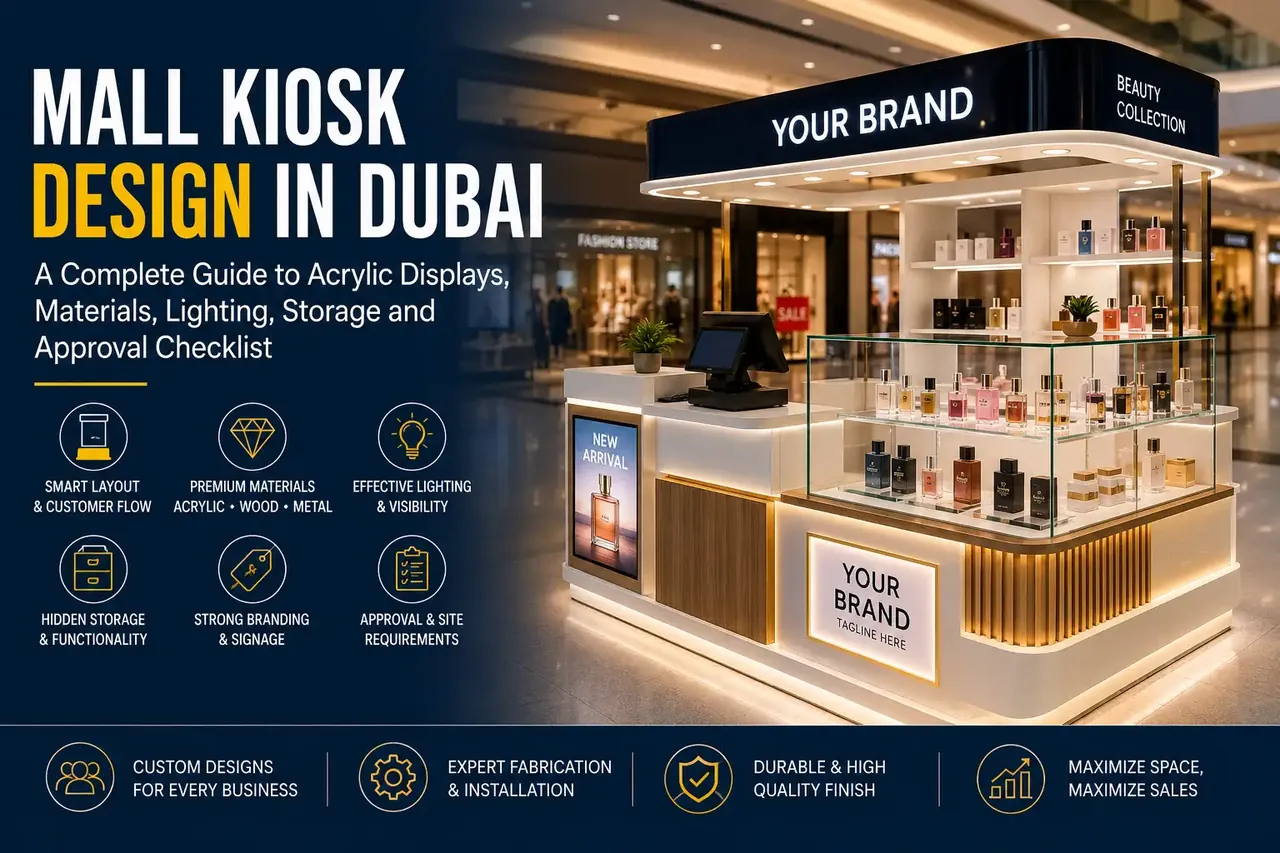
A practical guide for Dubai retailers, perfume brands, cosmetic companies, food businesses and event teams planning custom mall kiosks and pop-up counters.
A mall kiosk has only a few seconds to catch attention. Shoppers may approach from several directions, and most will continue walking unless they quickly understand the brand, products and purpose.
For that reason, a successful kiosk needs more than an attractive 3D design. It needs a clear layout, visible products, useful storage, safe wiring and materials that suit the location.
This guide is for perfume brands, cosmetic companies, mobile accessory sellers, food businesses, event teams and mall tenants planning mall kiosk design in Dubai. It covers kiosk types, acrylic displays, lighting, storage, POS equipment, branding and site requirements.
Businesses that already have a location, approved measurements and a design brief can view the dedicated custom acrylic kiosks in Dubai service page for direct fabrication enquiries.
What Is a Retail or Mall Kiosk?
A retail kiosk is an open commercial unit inside a mall corridor, event venue, seasonal market or another high-footfall area. Unlike a complete shop, it usually has no enclosed customer area.
Staff may work from the centre or behind a service counter. Customers then browse, test products, pay or collect orders from the outer sides.
Kiosks generally fall into three categories:
- Temporary event kiosks
- Seasonal or pop-up kiosks
- Permanent mall kiosks
A short promotional event may only need lightweight modular panels and replaceable graphics. In contrast, a permanent kiosk may require joinery, metal framing, acrylic showcases, electrical systems, lighting and lockable storage.
Businesses use kiosks for direct sales, food service, demonstrations, enquiries, product launches and marketing activations.
Global Village includes kiosks, trolleys and promotional pop-ups among its official business opportunities. This shows that compact retail formats remain part of Dubai’s commercial market. Readers can review the current Global Village partner categories.
Why Kiosks Work for Dubai Retail Brands
A kiosk places the brand directly in a busy customer route. It also needs less floor area than a complete retail shop.
Therefore, businesses often choose kiosks when they want to:
- Test a product range
- Enter a new location
- Run a seasonal campaign
- Launch a new brand
- Sell from an event venue
- Reach shoppers from several directions
However, a smaller footprint also creates challenges. Every shelf, drawer and counter must serve a clear purpose.
When storage is weak, cartons, shopping bags and staff belongings quickly become visible. Likewise, poor customer-flow planning can block the payment area or hide the main products.
Common Kiosk Types in Dubai
Perfume and Cosmetics Kiosks
Perfume and cosmetic products need good visibility and easy tester access. Customers should see bottles, shades and product ranges without leaning across the staff area.
Useful features include:
- Illuminated shelves
- Acrylic product risers
- Tester trays
- Mirrored details
- Lockable stock cabinets
- Easy-to-clean counters
- Branded price holders
Clear acrylic keeps the display visually light. As a result, small bottles and product packaging remain the main focus.
Meanwhile, coloured or frosted acrylic can separate product categories or highlight premium collections.
Mobile Accessories and Electronics Kiosks
Electronics kiosks often carry many small items. Therefore, the layout must organise the products without turning the kiosk into a crowded wall of packaging.
Practical features include:
- Lockable display sections
- Product hooks
- Charging points
- Cable channels
- Demo areas
- Task lighting
- Concealed high-value stock storage
The payment point should not interfere with product testing. In addition, the team should plan ventilation around screens, chargers and other powered equipment.
Food and Beverage Kiosks
Food kiosks need a different planning process because equipment, preparation, cleaning, waste and service flow all affect the layout.
The design brief may need to cover:
- Service counter
- Menu boards
- Equipment dimensions
- Work surfaces
- Cleaning provisions
- Waste storage
- Stock access
- Staff movement
- Customer collection point
Dubai Municipality publishes requirements and services for food establishments. Therefore, food operators should check the rules that apply to their exact activity and location before approving the design.
Official information is available through the Dubai Municipality food traders and establishments section.
Jewellery and Accessories Kiosks
Jewellery and premium accessory kiosks need controlled viewing, accurate lighting and secure storage.
Common features include:
- Locked acrylic or glass showcases
- Product risers
- Soft display lighting
- Comfortable viewing heights
- Concealed stock drawers
- Clear staff sightlines
Security should form part of the initial design. Adding locks after fabrication can weaken doors, affect alignment and reduce the quality of the finish.
Event and Pop-Up Kiosks
Event kiosks need quick assembly and safe transport. They also benefit from branding that teams can update for future campaigns.
A reusable unit may include:
- Modular panels
- Removable acrylic displays
- Replaceable graphics
- Flat-pack parts
- Numbered assembly points
- Protective transport cases
- Adjustable shelves
A modular kiosk can support several events. However, the team must protect acrylic edges, lighting parts and printed surfaces during transport.
Planning Customer Flow Around the Kiosk
Before choosing colours or finishes, map how shoppers will approach the kiosk.
In many malls, people arrive from two or more directions. An island kiosk may receive traffic from all four sides.
Start by identifying:
- The busiest walking direction
- The first product customers should see
- The point where shoppers stop
- The product-testing area
- The payment point
- The collection point
- Staff entry and exit
Front-Facing Layout
A front-facing kiosk works when most shoppers approach from one direction. It supports one strong fascia, a hero-product zone and a clear payment area.
Still, the side panels should look finished because customers may see them before they reach the front.
Island Layout
An island kiosk stays visible from several sides. This format suits mall corridors and large public areas.
Since every side is exposed, the branding and finishing must remain consistent throughout the unit.
The designer should also prevent customers from accidentally entering the staff space.
Corner or L-Shaped Layout
An L-shaped counter can separate browsing from payment. It can also create extra room for stock and staff movement.
However, the inner corner must remain reachable. Poor planning can create a dead area that staff cannot use properly.
How Acrylic Fits into Retail Kiosk Design
Acrylic can support many kiosk elements without making the unit look heavy.
Common applications include:
- Clear product showcases
- Coloured shelves
- Product risers
- Tester trays
- Menu holders
- Price holders
- Protective screens
- Illuminated logo panels
- Branded side details
- Lockable display doors
Clear acrylic allows light to pass through the display and keeps attention on the products.
Meanwhile, coloured acrylic can reinforce the brand identity. Frosted finishes can also add privacy to selected storage or service areas.
However, acrylic should solve a display need. Covering every surface with it may increase glare, fingerprints and cleaning requirements.
A better approach combines acrylic with suitable joinery and metal support. For showcases, risers, illuminated details and branded panels, see acrylic retail kiosk fabrication in Dubai.
Acrylic vs Wood, Metal and Glass
Most well-designed kiosks use several materials. Each material performs a different job.
Acrylic
Acrylic is lightweight, clear and easy to shape. Fabricators can cut, bend, engrave and print it.
Therefore, it suits:
- Product displays
- Shelves
- Risers
- Tester trays
- Logo panels
- Protective covers
MDF and Wood
MDF and other joinery materials work well for counters, cabinets and main body panels. They also accept laminates, paint and decorative finishes.
However, the selected finish must suit the site, cleaning routine and expected operating period.
Related carpentry and joinery work in Dubai can support the structural body, cabinets and concealed storage areas.
Metal
Metal adds structural support. It suits frames, brackets, trims, shelf supports and modular connections.
A well-planned metal frame can reduce movement during transport and daily use. It can also support heavier panels without adding too much visible bulk.
Glass
Glass offers strong scratch resistance and a premium appearance. It works well for selected jewellery and luxury display areas.
On the other hand, glass weighs more than acrylic. It also needs careful transport, edge protection and fitting.
A Balanced Material Mix
A practical kiosk may use:
- Metal for the hidden structure
- Joinery for the body and storage
- Acrylic for displays and branding
- Glass for selected showcases
- LEDs for product lighting
- Printed graphics or 3D letters for identity
Practical approach: use each material where it performs best. Acrylic should support visibility and branding, while joinery and metal provide the main structure and storage.
Display Planning and Product Visibility
Customers should understand the product range without asking where to look.
Place priority products at eye level. Then use lower shelves for larger packs, refill stock or secondary items.
Small products may need risers so one row does not hide another.
Good display planning also includes:
- Readable price labels
- Space around hero products
- Separate tester areas
- Secure displays for valuable items
- Clear product categories
- Easy staff access for restocking
- Lighting without harsh glare
Custom acrylic display stands in Dubai can support perfumes, cosmetics, electronics, jewellery and promotional products inside a kiosk.
Storage Without Making the Kiosk Look Heavy
Storage often decides whether a kiosk remains tidy after opening day.
Plan space for:
- Sale stock
- Packaging
- Shopping bags
- Staff belongings
- Cleaning supplies
- Receipt rolls
- Marketing materials
- Cables and small equipment
Under-counter cabinets and lockable drawers usually work well. Pull-out trays can also make deep compartments easier to use.
Nevertheless, too much solid cabinetry can make a kiosk look closed and bulky.
A balanced layout uses open product displays above and concealed storage below.
Kiosk Lighting Guide
Lighting should help customers see the products accurately. It should not compete with them.
General Illumination
General lighting makes the kiosk visible from a distance. It may come from overhead features, fascia lighting or an integrated frame.
Shelf Lighting
Shelf lighting highlights small products. It works particularly well for perfumes, cosmetics, jewellery and electronics.
Where possible, hide the LED source. Visible light dots and loose wires can make a newly installed kiosk look unfinished.
Backlit Branding
Backlit logos, illuminated fascias and acrylic edge lighting can strengthen brand recognition.
Still, the brightness should suit the surrounding location. A kiosk does not need to overpower nearby stores.
Task Lighting
Task lighting supports payment, product testing and customer service.
Food kiosks may also need focused lighting around preparation or handover areas, depending on the applicable site and activity requirements.
Lighting Mistakes to Avoid
Common problems include:
- Excessive brightness
- Dark shelves
- Mixed LED colour temperatures
- Visible wires and drivers
- Lights that alter product colours
- Strong reflections on clear acrylic
- No access for repairs
Ask the fabricator to test the full lighting system before delivery. This test makes it easier to correct dark areas and colour differences in the workshop.
Branding and Signage for a Mall Kiosk
A kiosk needs a clear name and a visible purpose. Shoppers should understand what the brand sells before they reach the counter.
Possible branding areas include:
- Main fascia
- Illuminated logo
- Counter front
- Side panels
- Product category signs
- Digital screens
- Menu boards
- Price panels
If the design includes English and Arabic, prepare both versions early. This gives the designer enough space to balance the text.
It also prevents one language from looking like a late addition.
For custom logos, lettering and branded panels, acrylic signage in Dubai can support the kiosk identity.
POS, Electrical and Technology Planning
Electrical planning should begin before fabrication.
Confirm the location of:
- POS terminal
- Card machine
- Receipt printer
- Router or data point
- Digital screen
- LED drivers
- Power sockets
- Charging points
- Equipment isolators
- Spare electrical capacity
Next, create a cable route that staff can reach without exposing wires to customers.
Ventilation also matters around screens, chargers and power supplies. Heat inside a closed cabinet can shorten equipment life and increase maintenance.
Temporary vs Permanent Kiosks
Temporary Event Kiosk
A short event needs lightweight parts, quick assembly and replaceable branding.
The team may prioritise transport and setup time over heavy storage or permanent wiring.
Seasonal Pop-Up Kiosk
A seasonal unit needs more strength than a one-day counter. It should handle repeated assembly, dismantling and transport.
Modular parts can help the brand reuse the unit across several campaigns.
Permanent Mall Kiosk
A permanent kiosk needs a stronger structure, higher-quality finishes and integrated electrical systems.
It also needs a clear plan for cleaning, repairs and replacement parts.
Before production, confirm the expected operating period. A weekend promotional counter should not use the same construction as a kiosk intended to operate for several years.
Approval and Site-Requirement Checklist
Dubai does not have one identical approval path for every kiosk. Requirements may differ by mall, landlord, venue, authority and business activity.
The Dubai Building Code includes kiosks within retail occupancies. It also sets minimum requirements related to health, safety, welfare and convenience in building design.
Before fabrication, ask the mall, landlord, consultant or venue to confirm:
- Allocated width and depth
- Maximum permitted height
- Required clearances
- Accepted materials and finishes
- Electrical load
- MEP requirements
- Fire and safety conditions
- Signage dimensions
- Branding restrictions
- Floor-fixing rules
- Accessibility requirements
- Installation hours
- Permit-to-work procedures
- Removal and reinstatement terms
Food, cosmetic, fragrance and other regulated activities may need additional checks. Therefore, the business should confirm the requirements that match its exact operation.
Project teams can review the official Dubai Building Code for general building-design context.
Documents to Prepare Before Fabrication
A complete information pack reduces revisions and delays.
Prepare:
- Site plan
- Confirmed kiosk dimensions
- 3D design
- Plan and elevation drawings
- Material schedule
- Electrical layout
- Equipment list
- Branding artwork
- Structural details where requested
- Mall or landlord comments
- Final approval record
Keep one approved version of every drawing. Otherwise, the workshop may receive conflicting measurements or outdated comments.
What Affects Kiosk Fabrication Cost in Dubai?
Kiosk pricing depends on the specification, not only the floor area.
Main cost factors include:
- Overall dimensions
- Temporary or permanent construction
- Acrylic quantity and thickness
- Joinery work
- Metal structure
- Display cabinets
- Lighting
- Digital screens
- Electrical work
- Branding and signage
- Storage requirements
- Site access
- Installation timing
- Transport
- Quantity
- Design revisions
A simple promotional counter will cost less than a permanent island kiosk with secure displays, digital screens, integrated lighting and substantial storage.
Therefore, request a quotation based on confirmed dimensions and a clear scope. An early estimate may change when the design, equipment or site conditions become clear.
Common Mistakes That Delay Kiosk Projects
Avoid these problems:
- Starting fabrication before design approval
- Using estimated site measurements
- Ignoring height and clearance limits
- Planning too little storage
- Leaving electrical planning until the end
- Blocking customer circulation
- Using weak locks for valuable products
- Installing long acrylic shelves without support
- Hiding drivers behind sealed panels
- Providing low-resolution logos
- Ordering too close to the opening date
- Selecting finishes before checking site acceptance
The best time to correct these issues is during design, not during installation.
Kiosk Quotation Checklist
Before requesting a quotation, prepare:
- Kiosk location
- Available width and depth
- Maximum permitted height
- Business type
- Products or services offered
- Temporary or permanent use
- Required counters and displays
- Acrylic display requirements
- Storage quantity
- Lighting needs
- POS and power equipment
- Logo and artwork files
- Mall or landlord guidelines
- Installation deadline
- Site photographs
- Approved design or reference concept
These details help the fabricator quote suitable materials, production work, transport and installation.
Why Local Fabrication Matters
A local fabrication team can measure the site, respond to drawing comments and coordinate with the installation schedule.
It can also support:
- Replacement acrylic parts
- Lighting repairs
- Graphic changes
- Additional shelves
- New branch kiosks
- Matching product displays
- Reinstallation after an event
Local production also makes it easier to test materials, finishes and lighting before the kiosk reaches the site.
For retail, perfume, cosmetics, exhibition and promotional units, visit custom kiosk fabrication in Dubai.
Planning a Mall or Retail Kiosk in Dubai?
Share the approved kiosk dimensions, business type, product display needs, storage requirements, artwork and site guidelines. Acrylic Gallery Plus can help with custom acrylic displays, joinery, branding and kiosk fabrication.
View Acrylic Kiosk Fabrication ServicesFrequently Asked Questions
What materials work best for a mall kiosk in Dubai?
Most kiosks combine metal framing, joinery, acrylic, glass, lighting and printed branding. The right mix depends on the products, site rules, operating period and budget.
Can acrylic form the main kiosk structure?
Acrylic can form display sections, shelves, showcases, risers and branding panels. However, larger kiosks usually need joinery or metal support for the main structure.
What acrylic thickness suits product displays?
The right thickness depends on the shelf span, product weight, fixing method and expected use. Small risers may use thinner acrylic, while long shelves and lockable showcases need stronger material and suitable support.
How much storage should a retail kiosk include?
Storage should cover sale stock, packaging, staff belongings, cleaning materials and daily supplies. Review the expected stock level before finalising the cabinet layout.
Do mall kiosks need design approval?
Managed venues usually review kiosk dimensions, materials, signage, electrical details and installation plans. The exact steps depend on the mall, landlord, authority and business activity.
Can a kiosk include light boxes and illuminated logos?
Yes. A kiosk can include backlit logos, fascia lighting, shelf lights and menu light boxes. Plan the electrical load, brightness and maintenance access before fabrication.
What files are needed before kiosk fabrication?
Provide approved dimensions, plans, elevations, 3D visuals, material details, electrical information and suitable logo artwork. The mall or landlord may request additional documents.
How early should kiosk fabrication start?
Fabrication should start after the design and site measurements receive approval. Lead time depends on the kiosk size, materials, equipment, revisions and installation access.
Can a temporary kiosk be reused?
Yes. Modular parts, replaceable graphics and protected transport can support repeated use. However, reuse should influence the design from the beginning.
What affects retail kiosk fabrication cost?
Size, materials, displays, storage, lighting, electrical work, screens, signage, transport, installation and design revisions all affect the final cost.
Can kiosks include lockable acrylic display cases?
Yes. Lockable acrylic display cases suit jewellery, electronics, cosmetics and other valuable items. The lock, hinge, acrylic thickness and support need careful planning.
How should acrylic kiosk displays be cleaned?
Use a soft microfiber cloth with mild soap and lukewarm water. Avoid rough paper, abrasive pads and strong solvents because they may mark the surface. You can also review the official ACRYLITE acrylic care guidance.
Conclusion
A successful mall kiosk starts with a practical plan. It needs clear product displays, useful storage, controlled lighting, safe wiring and a layout that supports customer movement.
Acrylic can improve showcases, shelves, risers, tester areas and branding. However, it works best when the designer combines it with suitable joinery, metal support and lighting.
Before fabrication, confirm the site measurements, operating period, equipment list and venue requirements. Then approve the drawings, materials, electrical layout and branding.
When the team settles these details early, the kiosk looks better, works more efficiently and avoids costly changes during installation.