
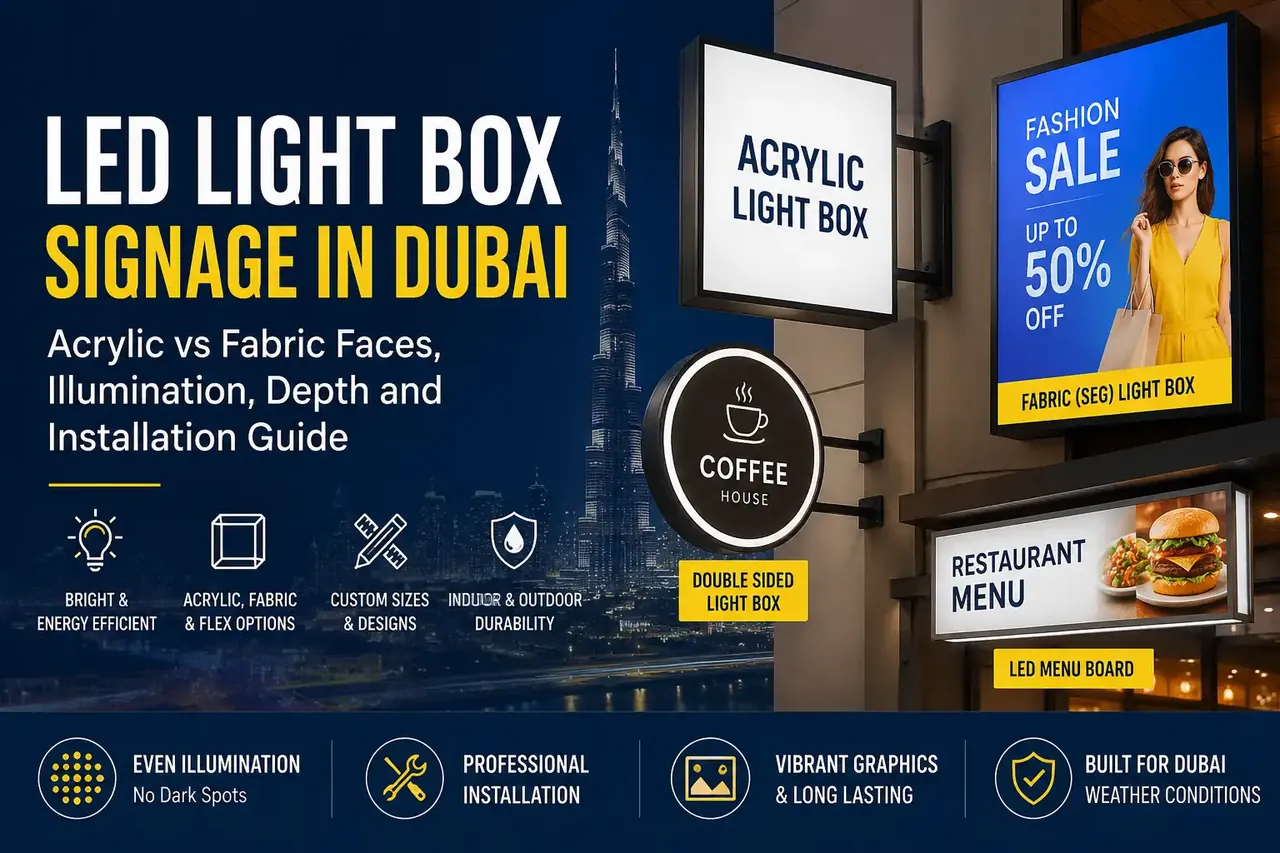
A practical guide for Dubai shops, restaurants, malls, clinics, hotels and offices choosing acrylic, fabric or flex-face illuminated signs.
A light box may look simple from the outside. However, the finished sign depends on several details hidden inside its frame. Face material, cabinet depth, LED spacing, power access, graphics and installation methods all influence the final appearance.
When one detail goes wrong, the face may show bright dots, dark corners, weak colours or unwanted shadows. In addition, a rigid front panel may bend when the frame lacks proper support.
This guide is for shop owners, restaurant teams, clinics, hotels, mall retailers, office fit-out companies and event organisers planning LED light box signage in Dubai. It explains acrylic, fabric and flex-face systems. It also covers illumination, depth, indoor and outdoor use, graphic changes, maintenance and quotation requirements.
Businesses that already know their required size and location can view the dedicated light boxes in Dubai service page for direct project enquiries.
What Is LED Light Box Signage?
An LED light box usually contains four main parts:
- A frame or cabinet
- Internal LED modules or strips
- A translucent front face
- Printed graphics, lettering or branding
The LEDs sit behind the visible face. They spread light across the panel and make the artwork readable after dark or in bright indoor environments.
Depending on the project, the face may use acrylic, silicone-edge fabric, flex material or translucent printed media. Each option creates a different finish and suits a different size range.
A light box also differs from illuminated 3D letters. A light box illuminates a complete graphic area. In contrast, illuminated letters light separate characters, symbols or logos.
Retail campaigns, menu boards and large product images often work well inside a light box. Meanwhile, reception logos and shop names may suit individual illuminated letters or other forms of acrylic signage in Dubai.
Where Dubai Businesses Use Light Boxes
Retail Shops and Mall Units
Retailers use illuminated boxes for:
- Shopfront branding
- Seasonal campaigns
- Product launches
- Promotional walls
- Offer displays
- Directional graphics
Fabric systems work well when a retailer changes its marketing image often. On the other hand, a rigid acrylic face can suit a permanent logo or compact illuminated sign.
Mall units also need tidy frames, controlled brightness and convenient maintenance access. Therefore, the project team should review the mall or landlord signage manual before approving the design.
Restaurants and Cafés
Restaurants commonly install illuminated menu boards, counter signs, offer panels and entrance signs.
Clear pricing and readable text matter more than decorative effects. Moreover, the business should plan how staff will update prices, dishes and promotions later.
Replaceable fabric graphics, removable acrylic panels or poster-style frames can reduce future costs. As a result, the restaurant can change the visible information without replacing the full cabinet.
Clinics and Offices
Clinics and offices often use light boxes for:
- Reception branding
- Service panels
- Department signs
- Directional signs
- Backlit logos
- Information displays
These locations usually need controlled brightness because visitors stand close to the sign. A very bright panel may feel uncomfortable inside a waiting room or reception area.
Although a shallow cabinet may look neat, it still needs enough space to spread the light. Otherwise, individual LED points can remain visible through the face.
Hotels, Exhibitions and Events
Hotels use illuminated boxes for lobby graphics, promotions and wayfinding. Event organisers use them for exhibition walls, product displays and portable branding.
SEG fabric systems suit many of these projects because staff can replace the printed fabric while keeping the main aluminium frame.
Acrylic, Fabric or Flex Face: Which One Should You Choose?
The face material affects the sign’s appearance, size, maintenance needs and graphic replacement process.
Acrylic-Face Light Boxes
Acrylic creates a rigid, clean front. It suits smaller and medium-sized signs, including reception signs, clinic branding, menu panels and internal directional signs.
Common acrylic-face options include:
- Opal acrylic
- Translucent printed vinyl
- Reverse-printed acrylic
- Layered acrylic details
- Raised letters or logo elements
Acrylic also works well when the design needs a firm panel or raised branding. However, large sheets may need extra support. Heat, overall size and frame construction can affect how flat the face remains.
SEG Fabric Light Boxes
SEG means silicone-edge graphics. The printed fabric carries a silicone strip around its perimeter. Installers press this strip into a channel in the frame.
This format suits:
- Large photographic graphics
- Mall campaigns
- Hotel interiors
- Exhibition walls
- Retail displays
- Seasonal promotions
Fabric creates an edge-to-edge image without a visible rigid front panel. It also makes later graphic changes easier.
Still, installers must tension the fabric evenly. Loose areas may wrinkle, while uneven fitting can distort text and photographs.
Flex-Face Light Boxes
Flex-face systems use tensioned flexible material. They often suit wider signs and selected outdoor applications.
Common uses include:
- Broad shopfront signs
- Large branding panels
- Outdoor displays
- High-level signage
- Wide-format illuminated cabinets
The frame must hold the face evenly. In addition, the installation team needs consistent tension on every side to prevent loose sections or ripples.
| Face Type | Best Suited To | Main Benefit | Graphic Replacement | Key Consideration |
|---|---|---|---|---|
| Acrylic | Reception signs, menu panels, smaller shop signs | Rigid and clean appearance | Depends on front construction | Large panels may need additional support |
| SEG Fabric | Retail campaigns, hotels, exhibitions and large graphics | Edge-to-edge image and easy updates | Usually straightforward | Fabric needs even tension |
| Flex Face | Wide shopfronts and selected outdoor signs | Suitable for larger formats | Replaceable with correct access | Frame and tension quality matter |
Choosing the Right Light-Box Depth
Frame depth affects how evenly the light reaches the front.
A very shallow cabinet places the LEDs close to the face. Consequently, the viewer may see individual bright points.
A deeper cabinet gives the light more room to blend before it reaches the front. However, depth alone does not solve every lighting issue. LED beam angle, module spacing, face opacity and internal reflection also affect the result.
The overall sign size matters as well. A compact menu panel may work with a slim frame. In contrast, a large wall graphic may need more depth, additional LEDs or a different lighting layout.
Practical advice: do not select the cabinet depth only because a thin frame looks attractive. Instead, test the proposed LEDs, face material and spacing together before approving the final construction.
How to Achieve Even Illumination
Keep LED Spacing Consistent
LED modules should follow a planned grid. Uneven gaps can create dark areas, while crowded sections may produce bright patches.
Corners need extra attention too. When the LEDs stop too far from an edge, the face can appear darker around the perimeter.
Match the Face to the Lighting System
Opal acrylic spreads light differently from printed fabric or translucent vinyl.
A face may look correct while unlit but appear too dark after illumination. Alternatively, it may allow too much direct light and reveal every LED point.
Therefore, the workshop should test the face material and print density with the selected LEDs.
Use a Reflective Internal Surface
A light-coloured interior helps redirect light towards the visible face. It can also reduce light loss inside the cabinet.
Meanwhile, wires, power supplies and structural parts should stay away from the direct lighting path. Poor internal placement may cast shadows on the front.
Test the Unit Before Installation
The workshop should run the complete sign before delivery. Ideally, the team should inspect it in a dim area and from the expected viewing distance.
During the test, check for:
- Visible LED points
- Dark corners
- Uneven colours
- Internal shadows
- Weak text contrast
- Distorted graphics
- Colour differences between sections
A short workshop test can prevent a difficult correction after installation.
Single-Sided vs Double-Sided Light Boxes
A single-sided light box usually mounts against a wall. It suits reception signs, menu boards, promotional walls, office branding and shop interiors.
A double-sided unit displays the same or different messages in two directions. Businesses often use it as a projecting sign, hanging sign or freestanding display.
This format helps customers who approach from either side of a walkway, corridor or shopfront.
However, double-sided signs need more planning. The frame must allow both faces to receive balanced light. The mounting system must also support the added weight.
Before fabrication starts, the team should plan the cable route, fixing point and future maintenance access.
Indoor and Outdoor Light-Box Specifications
Indoor Units
Indoor boxes often use slimmer frames because they avoid direct rain and severe weather.
Common indoor locations include:
- Reception walls
- Mall interiors
- Menu boards
- Offices
- Clinics
- Exhibition stands
Although indoor units avoid direct rain, they still need ventilation, safe wiring and convenient service access.
Outdoor Units
Outdoor units need stronger protection. The frame, face, electrical parts and fixing system must suit heat, dust, moisture and installation height.
Important outdoor details include:
- Weather-resistant frame construction
- Protected electrical connections
- Drainage where required
- Secure wall or façade mounting
- Accessible power components
- Suitable face material
- Safe maintenance access
Do not assume that every indoor acrylic light box can work outside. Instead, confirm the location and exposure before selecting materials.
Graphic and Branding Options
A light box can carry a simple logo or a full photographic campaign.
Common graphic options include:
- Translucent printed vinyl
- Reverse printing
- UV printing
- Cut vinyl lettering
- Raised acrylic letters
- Frosted areas
- Replaceable poster inserts
- SEG fabric graphics
Acrylic faces work well for fixed logos, coloured panels and raised details. Fabric faces suit large images and campaigns that change regularly.
The artwork should also suit the lighting method. Fine lines may disappear under strong illumination. Similarly, weak colour contrast may reduce readability.
For accurate acrylic logos, shapes and cut details, acrylic laser cutting and engraving in Dubai can support the production process.
How Custom Light Boxes Are Made
1. Site Measurement
The team should record:
- Available width and height
- Power-point location
- Wall or façade material
- Installation height
- Nearby doors and ceilings
- Cameras and sprinklers
- Access limitations
- Maintenance space
Clear site photographs also help the fabricator understand the installation area. As a result, the quotation and design can reflect the actual conditions.
2. Artwork Preparation
A vector logo usually gives the cleanest result for cutting and scaling. The artwork should also include the final dimensions, approved colours and a safe area around important text.
When a sign includes Arabic and English, the designer should balance both languages from the beginning. Each version also needs a final spelling check.
3. Frame and Face Fabrication
The workshop builds the frame according to the sign size, cabinet depth and mounting method. Next, the team prepares the acrylic, fabric or flex face.
At the same time, the fabricator plans the LED layout, wiring route and service access. These decisions play a major role in brightness and future maintenance.
4. Testing and Installation
Before installation, the workshop should test:
- Illumination
- Colour consistency
- Graphic alignment
- Power stability
- Fabric tension
- Cabinet access
After approval, installers mount the frame, complete the electrical connection and clean all visible surfaces.
Where polished acrylic parts remain visible, edge polishing and finishing in Dubai can improve clarity and edge quality.
Installation and Approval Checks in Dubai
Public-facing or external signage may need approval based on the property, project type and responsible authority.
Before production, confirm:
- Landlord or mall approval
- Developer design requirements
- Relevant authority requirements
- Electrical connection responsibility
- Installation timing
- Access-equipment arrangements
- Wall or façade condition
- Approved dimensions
- Final artwork approval
The process may vary by location. For example, a mall unit, free-zone property and street-facing shop may follow different site procedures.
Therefore, the owner, landlord, consultant and signage contractor should confirm the correct route for the specific project.
Businesses can also review the official Dubai Municipality business and regulatory information when checking requirements that may apply to external advertising or signage.
Common Light-Box Problems and How to Prevent Them
Visible LED Dots
Visible dots often appear when the cabinet is too shallow, the modules sit too far apart or the face does not diffuse enough light.
A workshop lighting test can identify this issue before installation.
Dark Corners
Poor edge coverage or internal shadows can create dark areas. Adjusting the module layout and internal reflection usually improves the result.
Uneven Brand Colours
Backlighting changes the way printed colours appear. Therefore, approve a printed sample under the intended light source when colour accuracy matters.
Acrylic Face Bowing
Large rigid panels may need thicker acrylic, additional support or a different face system. The frame should hold the panel without placing unnecessary stress on it.
Loose Fabric Graphics
SEG fabric needs even tension around the frame. Installers should fit the silicone strip fully into the channel and check every corner.
Difficult Maintenance Access
A sign may work correctly on the first day but become expensive to maintain if technicians cannot reach the LEDs or power supply.
Plan maintenance access before building the cabinet.
Weak Wall Fixing
The fixing method must match the sign weight and wall construction. A gypsum partition, concrete wall and external façade require different fixing plans.
What Affects Light-Box Cost in Dubai?
Pricing depends on the complete specification rather than size alone.
Main cost factors include:
- Overall width and height
- Acrylic, fabric or flex face
- Single-sided or double-sided construction
- Cabinet depth
- LED quantity and arrangement
- Printing method
- Indoor or outdoor specification
- Graphic replacement system
- Installation height
- Access equipment
- Electrical preparation
- Order quantity
- Required completion date
A project-based quotation gives a more accurate figure than a fixed price per square metre.
Two signs with the same dimensions can have different costs. For instance, one may need outdoor protection, double-sided lighting or difficult high-level installation.
Buyer Checklist Before Requesting a Quotation
Prepare the following details:
- Installation location
- Indoor or outdoor use
- Final width and height
- Single-sided or double-sided design
- Preferred acrylic, fabric or flex face
- Fixed or replaceable graphic
- Logo and artwork files
- Available power point
- Wall or mounting surface
- Installation height
- Landlord or mall requirements
- Required completion date
- Quantity
- Clear site photographs
These details help the supplier recommend a suitable frame, face material, lighting arrangement and installation method.
Why Local Fabrication Matters
Local fabrication allows the supplier to measure the site, correct artwork quickly and coordinate installation with the fit-out programme.
It also helps when the project later needs:
- Replacement graphics
- Electrical maintenance
- New branch signs
- Matching promotional displays
- Updated printed faces
- Repairs or adjustments
More importantly, the workshop can test the actual face material with the proposed LEDs. This step reduces the risk of visible bright points, dull colours and uneven lighting.
For dimensions, materials and project-specific recommendations, visit the custom LED light boxes in Dubai service page.
Planning an LED Light Box for Your Dubai Business?
Share the required size, installation location, face preference, artwork, power details and site photographs. Acrylic Gallery Plus can help with acrylic, fabric and custom illuminated sign options.
View Light-Box Fabrication ServicesFrequently Asked Questions
Which is better for a Dubai shop: an acrylic or fabric light box?
Acrylic suits smaller rigid signs, logos and menu panels. Fabric works well for larger images and campaigns that change regularly. The correct option depends on the size, location and graphic replacement needs.
How deep should an LED light box be?
No single depth suits every sign. The required depth depends on the face material, LED spacing, overall dimensions and brightness target. A workshop test helps confirm the correct construction.
Why can I see individual LED dots through the face?
Visible dots usually appear when the LEDs sit too close to the face, the modules have wide gaps or the front material does not diffuse enough light.
Can acrylic light boxes be installed outdoors?
Yes, when the complete unit has a suitable outdoor specification. The frame, wiring, drainage, power supply, face material and mounting system must match the site conditions.
Can the graphic be replaced without changing the frame?
Yes. SEG fabric systems and selected poster-style light boxes allow businesses to replace the visible graphic while keeping the main frame.
Are double-sided light boxes available?
Yes. Double-sided units work well as projecting, hanging or freestanding signs. They require a suitable frame, balanced internal lighting and a secure mounting method.
What artwork file should I provide?
Vector files such as AI, EPS, SVG or a suitable print-ready PDF work best for logos and cut details. Large fabric graphics may also require high-resolution image files.
Do external shop signs require approval in Dubai?
Requirements depend on the sign type, property, landlord, developer and responsible authority. Confirm the correct process for the specific location before fabrication starts.
How should an acrylic light box be cleaned?
Switch off the unit first. Then use a soft microfiber cloth with mild soap and lukewarm water. Avoid rough paper towels, abrasive pads and unsuitable solvents. You can also review the official ACRYLITE acrylic care guidance.
What information is needed for an accurate quotation?
Provide the size, location, indoor or outdoor requirement, face type, artwork, mounting surface, installation height, available power, quantity and clear site photographs.
Conclusion
A good light box depends on more than bright LEDs. Face material, cabinet depth, module spacing, artwork and installation all shape the final result.
Acrylic works well for rigid signs, compact logos and menu panels. Fabric suits larger graphics and regular campaign changes. Meanwhile, flex face can suit wide signs and selected outdoor applications.
In every case, the unit needs even illumination, safe wiring, stable fixing and access for future maintenance.
Before ordering, confirm the site requirements and provide accurate measurements, artwork and photographs. For production, installation and quotation support, visit light-box fabrication in Dubai.