
For a solid acrylic rod, give the diameter and finished length. For a hollow acrylic tube, give the outside diameter, inside diameter and finished length. If you only know the wall thickness, send that with the outside diameter. Say how many pieces you need and what has to fit inside or around them.
Are you buying a full length or twelve finished pieces?
Blue Rhine’s UAE catalogue gives a local example. Its clear acrylic tube measures 30 × 26 × 2,000 mm. That means 30 mm across the outside, 26 mm across the opening and two metres from end to end. If you want a full length, ask the supplier to confirm that exact size is in stock, the minimum quantity and the collection or delivery date.
A different question gets you a better quote for a finished display. Suppose you need twelve sleeves, each 120 mm long. Together they use 1,440 mm of tube before trimming and material lost to the cuts. Ask for a price for all twelve, cut square and finished on the visible rim. You can then compare two quotes on the same terms. A price per metre tells you little about the cost of the finished pieces.
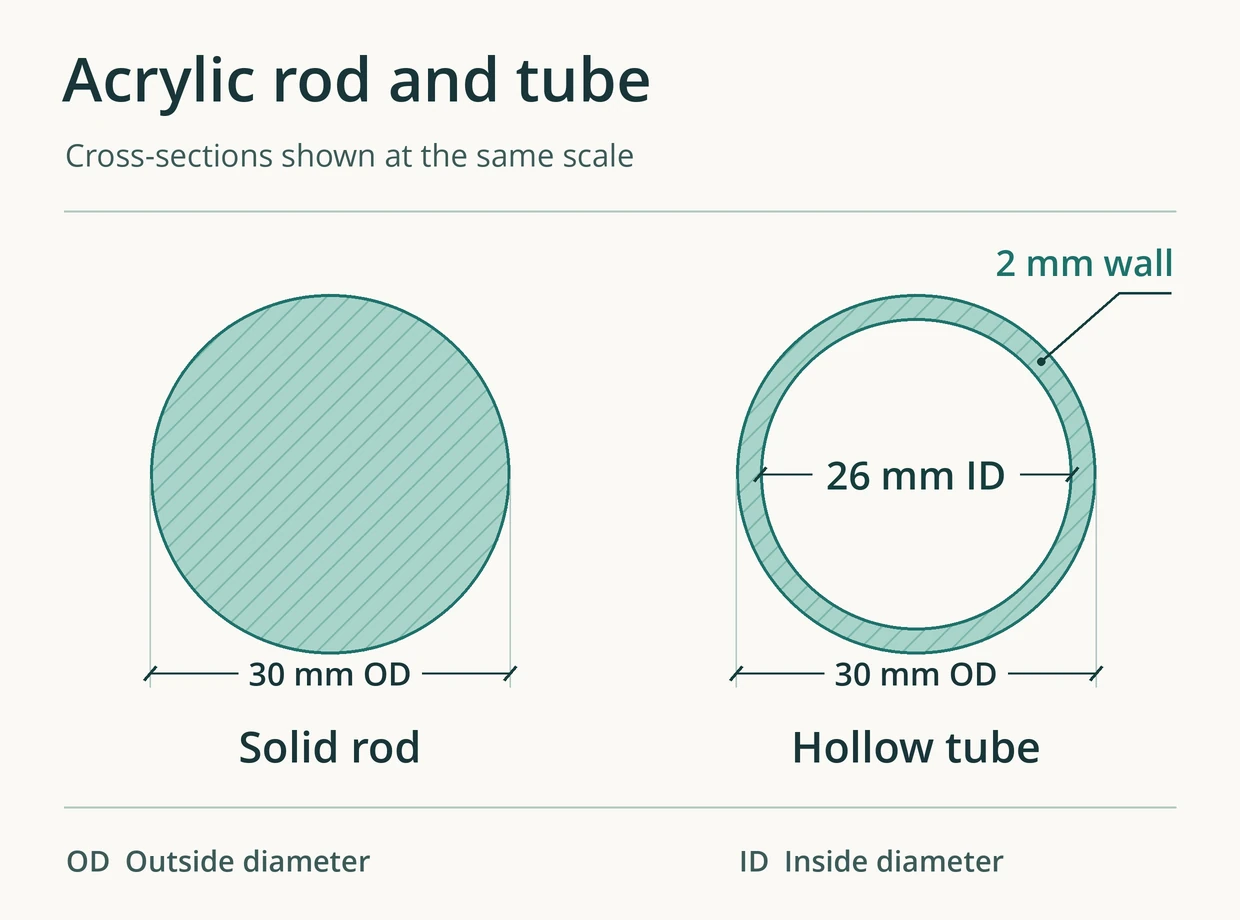
When does a display need a rod, and when does it need a tube?
Think of the clear posts behind a row of perfume testers. If you want an uninterrupted circle of acrylic at the top, a solid rod gives you that face. Mark how much of the post sits inside the base. A drawing that calls for 150 mm above the counter and a further 10 mm in the socket needs a 160 mm finished rod. A cut list that says only “150 mm” leaves the post 10 mm short.
A removable sleeve calls for a tube. Measure the widest part it has to pass over. A peg might be 25 mm along its shaft and wider at a screw head or collar. If the sleeve catches there, it will never reach the base.
How much room is inside a 30 mm acrylic tube?
The outside diameter (OD) matters when a tube sits in a hole or a cap slips over the end. The inside diameter (ID), also called the bore, matters when something slides into it. These four sizes appear in the PLEXIGLAS technical sheet for tubes and rods.
| Outside diameter | Wall thickness | Inside diameter |
|---|---|---|
| 30 mm | 2 mm | 26 mm |
| 30 mm | 3 mm | 24 mm |
| 30 mm | 4 mm | 22 mm |
| 30 mm | 5 mm | 20 mm |
There’s a wall on each side of the opening. Subtract twice the wall thickness from the outside diameter to find the nominal bore. For the first tube, that’s 30 − (2 × 2) = 26 mm.
Will a 25 mm insert slide into a 26 mm bore?
On paper, yes. You have 1 mm of clearance across the diameter, or 0.5 mm on each side when the insert is centred. The catalogue gives nominal sizes. The actual tube and insert can each vary slightly, so ask for the manufacturer’s tolerances if the fit is close.
Before ordering a batch, try your insert in a sample sleeve at the finished length. Slide it all the way in, then pull it out the way a member of staff would when changing the display. If there’s a cap, take it along. A plug fits inside the bore. A cap with a lip that wraps around the tube needs the outside measurement.
What should go on the cutting sketch?
- Dimensions and quantity. Use millimetres throughout. List each cut length and its piece count. If your drawing specifies extruded acrylic, include that detail alongside the dimensions.
- Visible ends. Mark the end that faces the customer. You might want a polished finish on the top of a clear post. Mark a concealed or bonded end separately so the workshop can prepare it for the joint.
- What the part carries. For a post that supports a product, give the product’s weight, where it sits and how the post attaches to the base. A side view is more useful here than a photo taken from above.
A sample enquiry you can send to a Dubai workshop
Could you quote for 12 clear acrylic sleeves for a perfume counter? Each piece should be 120 mm long, with a 30 mm outside diameter and a 26 mm nominal bore. Our insert is 25 mm at its widest point. Only the top rim will show. Please price one sample first and the other eleven once we’ve checked the fit.
Acrylic Gallery Plus makes custom acrylic display stands in Dubai. If the rods or sleeves are part of a complete stand, send a sketch showing where they sit, along with the product dimensions, quantity and required date. If you already have the peg or cap, mention it in your enquiry to the Al Quoz workshop. That gives the fabricator a real part to check against the drawing.