
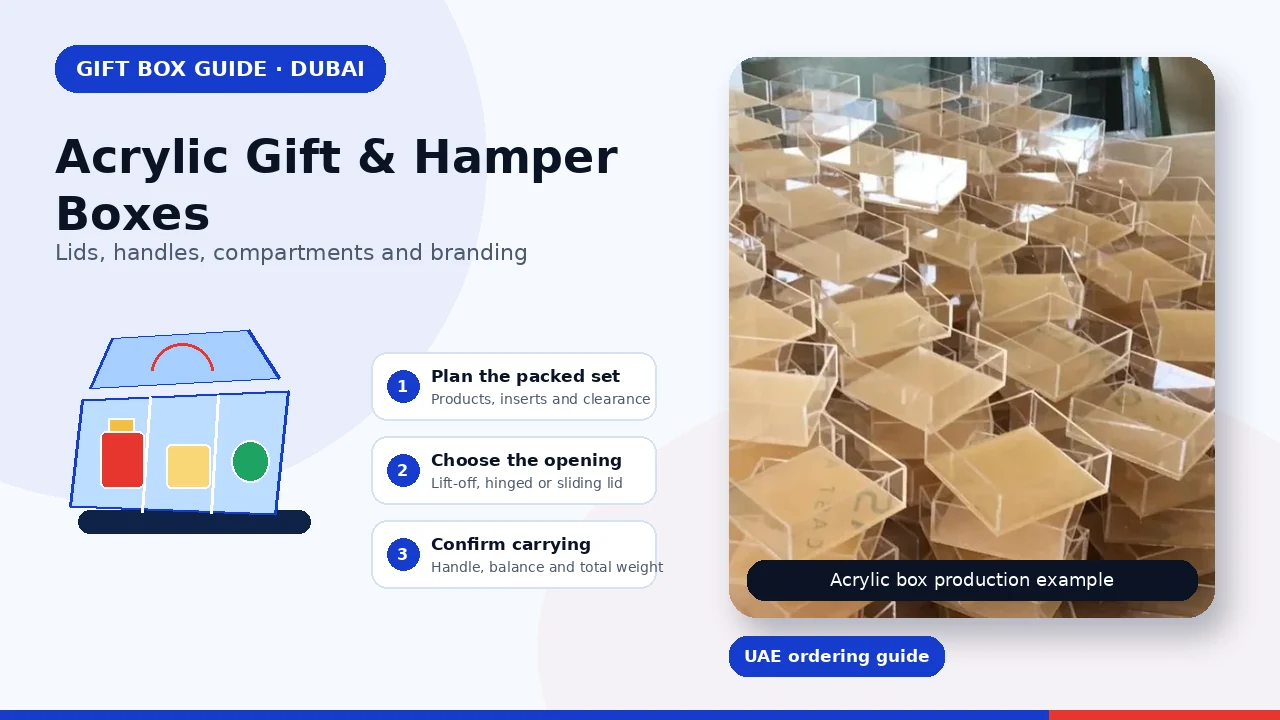
Acrylic works well when the contents are meant to remain visible. That is why it is often considered for corporate gift sets, perfume collections, packaged dates or chocolates, event gifts, flower arrangements and branded presentation kits. The clear box is only one part of the job, though. The internal layout, opening action and way the recipient carries the set usually decide whether the finished piece feels considered or frustrating.
The focus here is custom-fabricated presentation packaging. Direct food contact is a separate question: the acrylic grade, adhesive, print, insert and liner all need to suit the intended use. Very heavy contents may also need a structural check.
The decisions that shape a gift box before it reaches the workshop
| Box decision | Useful input | Effect on the finished set |
|---|---|---|
| Packed contents | Product list, individual sizes, weights and final orientation | The box must fit the complete set after wrapping, liners and dividers are added. |
| Internal size | Clear length, width and height required inside the box | External dimensions do not show the usable space after panel thickness and hardware. |
| Lid or opening | Lift-off, hinged, sliding, removable panel or open tray | Changes access, hardware, overlap, hand clearance and display position. |
| Carrying | Total packed weight, handle type and carrying distance | A decorative handle is not automatically suitable for a heavy hamper. |
| Compartments | Fixed or removable dividers, trays, recesses and clearance | Prevents products from moving and keeps the presentation tidy. |
| Branding | Vector logo, names, colours, placement and viewing direction | The artwork method and panel layout should be agreed before fabrication. |
| Contents and environment | Packaged food, liquids, flowers, chilling, sunlight or frequent cleaning | May affect sheet grade, liners, openings, chemical contact and care advice. |
| Quantity and deadline | Prototype, first batch, repeat quantity and required delivery date | Sampling, artwork approval, packing and repeat consistency need time. |
Start with the packed gift set
The safest starting point is a table with every item placed in its final position. Include the product packaging, tissue, sleeves, cards, ribbon, bottles, trays and any raised display platform. A bottle that measures 80 mm wide may need more room once its cap, outer carton and finger clearance are considered.
Measure the largest footprint and the highest point after the set is arranged. Then decide how much space the recipient needs to remove each item without tipping the box. A tight layout can photograph well but become impractical when the first product cannot be lifted out.
If the arrangement is not final, send the physical products or dimensioned samples. A marked top-view sketch also works for the first review. Label items that may change between orders so the divider design can allow sensible tolerance.
Internal dimensions are more useful than a guessed outside size
State whether each dimension is internal or external. For a box with thick panels, a fitted lid, hinges or an internal tray, the difference can be significant. Internal dimensions tell the fabricator what must fit. External dimensions become important when the hamper must sit inside a shipping carton, shelf, display unit or event installation.
Allow room for wrapping and human hands
Gift sets are handled differently from storage boxes. Someone may need to lift a perfume bottle by its shoulders, slide out an envelope, hold the lid open and remove a central product without disturbing the rest. Build that movement into the layout. A few millimetres saved on paper can create an annoying box in practice.
Choose the opening before finalising the build
The lid affects the look, the hardware and the way the box is used. It should be selected before the panel thickness and compartment positions are fixed.
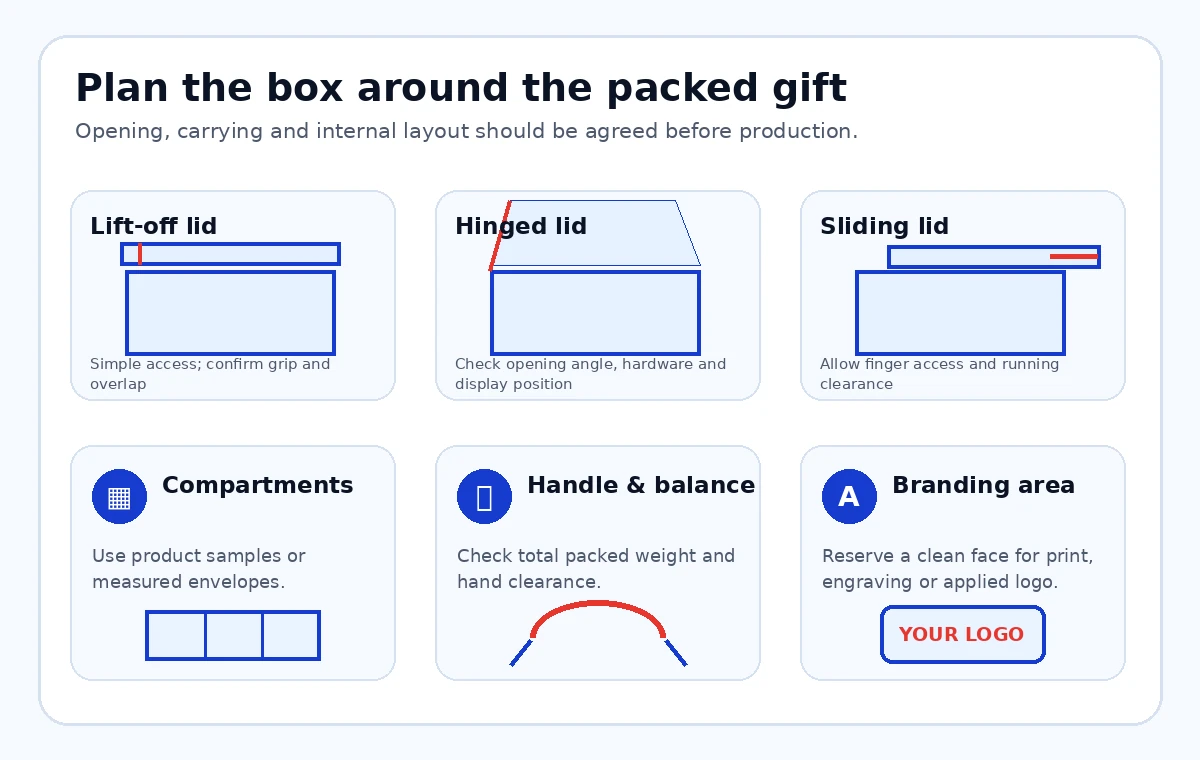
Lift-off lid
A separate lid keeps the sides visually clean and allows full access to the contents. The overlap must be deep enough to sit securely but not so tight that the lid jams. If the lid is large, the user also needs a comfortable way to grip and place it down without scratching it.
Hinged lid
A hinged lid remains attached, which is useful when parts should not be separated. The design needs space behind the box, a suitable opening angle and hardware that suits the lid size and expected use. Compartments should not block hinge fixings, and the open lid should not pull the box backwards.
Sliding lid
A sliding panel can create a neat presentation, especially for flatter gift sets. It needs a controlled running clearance, a stop or removal method, and enough finger access to open it. Decorative inserts must stay below the sliding path.
Open tray, sleeve or removable front panel
Some hampers work better as an open tray that receives a separate wrap, sleeve or outer carton. A removable front can help when the contents should be presented without lifting them from above. These formats should be discussed with the fabricator and packing supplier together so the parts fit as one set.
Handles and carrying need a weight check
A handle changes a display box into a carried object. Before adding one, calculate the complete packed weight. Include the acrylic, products, bottles, jars, decorative filler and lid. Then decide how far the box will be carried and whether it will be lifted by one hand or two.
Cut-out hand holes
Cut-outs keep the handle within the panel, but they reduce material around the opening and must be positioned where the load is balanced. Sharp internal corners should be avoided. The hand opening also needs enough clearance once the box is full.
Applied acrylic handles
A separate handle can create a strong visual feature. Its fixing area, grip size and relationship to the lid need review. A handle attached only for appearance should not be treated as load-bearing unless the complete design has been checked for the intended weight.
Ribbon, rope or mixed-material handles
Soft handles may suit an event or seasonal presentation, but the holes, knots, end fittings and abrasion points must be planned. Confirm whether the external material is supplied by the acrylic fabricator, the gift packer or another vendor. Colour matching should be approved from a physical sample where it matters.
For heavy sets, a rigid base or separate carrying carton may be safer than relying on the acrylic box alone. The best answer is not always the most decorative handle.
Compartments, inserts and false bases
Good internal organisation makes the box feel intentional. It also stops products from striking the acrylic during transport. The layout can use fixed dividers, removable partitions, a raised platform, a lower storage space or a separate tray.
Fixed dividers
Fixed partitions are suitable when the product set will not change. They provide a consistent arrangement for repeat batches. Their position should be based on actual product envelopes, not only catalogue dimensions.
Removable dividers
Removable parts give more flexibility for seasonal or client-specific gifts. They need a clear locating method so they do not rattle or tilt. If staff will reconfigure the box, keep the system easy to understand and avoid small loose pieces that can be lost.
Raised platforms and hidden storage
A false base can bring small products closer to the lid and create space below for a card, cable, extra item or fixing. It also changes the usable height and the centre of gravity. Mark any hidden storage on the drawing so the lid, handle and compartments are checked with the full assembly.
Fabric, foam or paperboard inserts
Soft inserts can protect glass bottles and give colour to a clear box. The acrylic drawing should include the insert thickness and how it is held. If another supplier makes the insert, agree which party owns the final fit. A physical sample is often safer than passing dimensions between vendors.
Plan around the product category
An acrylic gift box for perfume is not specified in the same way as a flower hamper or a set of packaged dates. The contents affect weight, chemical contact, access and cleaning.
Perfume and cosmetic gift sets
Bottles can be heavy and may leak if damaged. Give each bottle support around the base and enough space around the cap. If testers or oils may contact the acrylic, ask the workshop to review the likely chemical exposure. Printed branding and soft inserts should also be checked against the products.
Corporate gifts and welcome kits
These often mix items of different heights: notebooks, cards, small devices, bottles and branded merchandise. A tiered layout can keep the products visible. Repeat orders benefit from an approved packing diagram so each set is assembled the same way.
Packaged chocolates, dates and dry foods
Keep food in its intended packaging unless the exact acrylic grade and every component of the box are confirmed for direct contact. Adhesives, prints, liners and hardware matter as much as the sheet itself. Add enough space for the food packaging and for easy removal without crushing it.
Flowers and preserved arrangements
Fresh flowers can introduce moisture. Preserved arrangements may use chemicals or dyes. State whether the box is only a dry display cover or part of a live arrangement. Drainage, ventilation, liners and cleaning access should be decided before production.
Wedding and event gifts
Names, dates and short-run personalisation may change from unit to unit. Create a clear artwork list and proofing process. Check transport carefully because event boxes often move in batches and are handled by several teams before reaching the recipient.
Material, colour and edge finish
Clear acrylic is popular because the contents remain visible, but colour can be used with restraint. A tinted base, frosted divider or mirror accent may support the brand without hiding the products. Every decorative material should be reviewed against the intended lighting and photography.
Thickness follows size, span and use
There is no single sheet thickness for all hamper boxes. A small lift-off lid and a large carried box do not behave the same way. The fabricator should review panel span, total load, opening style, handle, hardware, compartment support and the feel expected from the finished piece.
Clear edges show the quality of the build
On a transparent box, joints and edges remain visible. Discuss polished edges, bonded corners, mitres or other construction details before approving the look. A reference image can help explain the visual direction, but the final drawing should show how the box is actually assembled.
Protective film is not the finished surface
Acrylic sheets normally arrive with protective masking. The colour and texture seen through that film may not represent the final panel. Keep protection in place through suitable fabrication stages, then inspect the uncovered product under the lighting where it will be presented.
Branding and personalisation
Reserve the branding area before compartments and handles are positioned. A logo can look centred on an empty panel and appear misplaced once the products are packed behind it.
Direct printing
Printing can carry colour artwork, names and campaign graphics. Confirm whether the print is viewed from the front or through clear acrylic from the reverse. White ink, opacity and background colour can affect the final appearance.
Laser engraving
Engraving suits line art, names and permanent text. The contrast depends on the sheet, viewing angle and lighting. Ask for a sample when fine detail or a specific visual effect is important.
Vinyl graphics
Vinyl can suit short campaigns, names or graphics that may later be changed. Edge position, cleaning and repeated handling should be considered. Confirm whether the artwork is supplied as finished vinyl or applied during fabrication.
Applied logos and decorative plates
A separate acrylic logo, metal plate or printed plaque can create depth. It adds weight and fixing points, so it should be included in the drawing rather than attached after the box is complete.
Supply vector artwork where possible. State the required colour reference, final size, panel, reading direction and any variable names. For a repeat order, keep the approved artwork and placement drawing with the box specification.
Food contact, liquids and cleaning
Some manufacturers document selected transparent, colourless acrylic grades for food-contact uses. That does not mean every acrylic sheet or finished gift box is automatically approved. The adhesive, print, liner, hardware and cleaning process must also suit the project. For unpackaged food, request the exact material declarations and confirm the full assembly with the responsible supplier.
Packaged foods are simpler, but spills still happen. Perfume, oils, cleaning chemicals and flower treatments can affect acrylic. State what may touch the surface. If a product leaks, wipe it promptly and follow the material supplier's care guidance.
For routine cleaning, use a soft, lint-free cloth with water and a small amount of mild detergent where appropriate. Do not treat acrylic like ordinary window glass. Abrasive pads and unsuitable cleaners can scratch, haze or stress the surface.
Transport and storage in UAE conditions
A gift box may spend time in a delivery vehicle, loading area or event storage room before it reaches an air-conditioned space. Tell the fabricator where it will be stored and how long it may remain in heat or direct sun. Avoid leaving packed boxes in extreme vehicle temperatures when the contents, adhesives, prints or decorative inserts may be affected.
Liquids and flowers can also create condensation. If the set is chilled, moved between temperatures or contains moisture, discuss ventilation and liners. A completely closed clear box can trap droplets that spoil the presentation.
Packing and delivery are part of the design
Clear acrylic reveals scratches quickly. Boxes should not rub against one another in transport. Confirm whether each unit needs a protective bag, tissue, foam corners, an individual carton or dividers inside a master carton.
If the hamper is packed after the acrylic box is delivered, provide handling instructions to the packing team. Keep hard tools, jewellery and rough surfaces away from exposed panels. Decide when protective film is removed and who performs the final inspection.
For large corporate batches, test one fully packed unit inside its shipping carton. Check lifting, stacking, lid security and product movement. A sample approved while empty is not enough.
What affects the cost of a custom acrylic hamper box?
- Overall internal and external dimensions
- Panel thickness, colour and finish
- Lift-off, hinged, sliding or removable opening
- Handle type and packed load
- Number of dividers, trays and false bases
- Hinges, magnets, locks or other hardware where required
- Printing, engraving, vinyl or applied logo work
- Prototype and sample approval
- Variable names or artwork between units
- Protective packing and delivery method
- Quantity, repeat schedule and required date
A reference photo can start the conversation, but it cannot produce a reliable price on its own. Send the packed layout and opening details so the quotation reflects the actual build.
A practical ordering sequence
- Arrange the set: place every product, insert and card in the intended layout.
- Measure: record the required internal space, overall size limits and packed weight.
- Choose access: agree the lid, handle and how the recipient removes each item.
- Plan organisation: mark fixed dividers, removable inserts, trays and hidden storage.
- Approve branding: provide vector artwork, colours, placement and variable names.
- Review the sample: pack the real products, carry the box, open it and inspect the graphics.
- Release the batch: keep the approved drawing and packing layout for repeat work.
The order can begin with a sketch. Before production, turn that sketch into an approved specification that both the fabricator and the gift-packing team understand.
Common mistakes to avoid
- Measuring products without their packaging. The final set becomes too tight once sleeves, labels and inserts are added.
- Choosing a handle before calculating weight. The box looks right but is uncomfortable or unsafe to carry.
- Leaving no space for fingers. The recipient cannot remove the first item cleanly.
- Adding branding after compartments are fixed. Products or dividers sit directly behind the logo and reduce readability.
- Assuming all acrylic is suitable for direct food contact. The exact sheet and every part of the finished assembly require confirmation.
- Approving an empty sample. Problems with balance, product movement and lid clearance appear only after packing.
- Ignoring transport. Clear boxes arrive scratched because they touch one another in a master carton.
- Sending a deadline without the quantity and artwork status. Sampling and variable personalisation cannot be planned properly.
Acrylic gift and hamper box quotation checklist
Send these details together:
- List of all products with dimensions and weight
- Photograph or top-view sketch of the packed arrangement
- Required internal length, width and height
- Maximum external size if it must fit a carton, shelf or display
- Lid or opening style
- Handle requirement and complete packed weight
- Fixed or removable compartments and insert thickness
- Clear, coloured, frosted or mirror-accent preference
- Logo file, colour reference, placement and variable names
- Contents that may leak, create moisture or contact the acrylic
- Prototype quantity, full quantity and likely repeat order
- Required delivery date, location and packing responsibility
If the product set is available in Dubai, a physical sample can answer questions that photographs cannot. Mark any items that may change between batches.
Material guidance referenced
These manufacturer pages support the general food-contact, chemical-contact and cleaning cautions in this guide. The declaration for the exact sheet and finished assembly still needs to match the project.
- Food-contact information for selected PLEXIGLAS grades
- Cleaning and care guidance for PLEXIGLAS
- Chemical-resistance guidance for PLEXIGLAS
What buyers usually want clarified before production
Can an acrylic hamper box be made to an exact size?
Yes, subject to fabrication and material limits. Send the required internal dimensions, the packed layout and any maximum outside size. State clearly whether each measurement is internal or external.
Which lid is best for a gift box?
It depends on how the set is presented and used. A lift-off lid gives full access, a hinged lid stays attached, and a sliding lid can suit flatter layouts. The products, available opening space and hardware should be reviewed before choosing.
Can the box include removable dividers?
Removable dividers can be planned where the layout and sheet thickness allow it. Provide the product sizes and explain which compartments need to change between gift sets.
Can names and company logos be added?
Branding may use printing, engraving, vinyl or an applied logo, depending on the artwork and required finish. Supply a vector file, colour reference, final size, placement and a list of any names that change between units.
Can an acrylic gift box have a carrying handle?
A handle may be possible, but it must be checked against the complete packed weight, balance, panel design and hand clearance. Heavy hampers may need a reinforced base or separate carrying carton.
Is an acrylic hamper box safe for chocolates or dates?
Packaged food can be placed inside a presentation box when the packaging protects the food. For direct contact with unpackaged food, confirm the exact acrylic grade and all adhesives, prints, liners and hardware against the relevant food-contact requirements.
Can the same box be reused?
Many gift boxes are designed for repeat use, but reuse depends on the construction, handling, cleaning and contents. Tell the fabricator that reuse matters so the lid, hardware, inserts and care guidance can be planned accordingly.
What information helps price a gift box accurately?
Send the product list, packed layout, internal dimensions, total weight, lid, handle, compartments, finish, branding files, quantity, required date and delivery location. Add a reference image only as supporting information, not as a substitute for measurements.
Build the brief around the packed gift, not an empty box
Lay out the final products exactly as the recipient should see them. Photograph that arrangement from above and note anything that may change between batches. From there, the box size, lid, dividers, handle and artwork can be discussed against one real layout instead of a guess.
Use the custom acrylic boxes service page for production enquiries. The broader acrylic box buyer guide covers general thickness, finish and construction choices; laser cutting and engraving and custom acrylic fabrication cover related processes.
Planning a gift set that needs its own box?
Bring the packed layout, internal size, total weight, artwork and required delivery date. Add the physical products or samples when fit is critical.