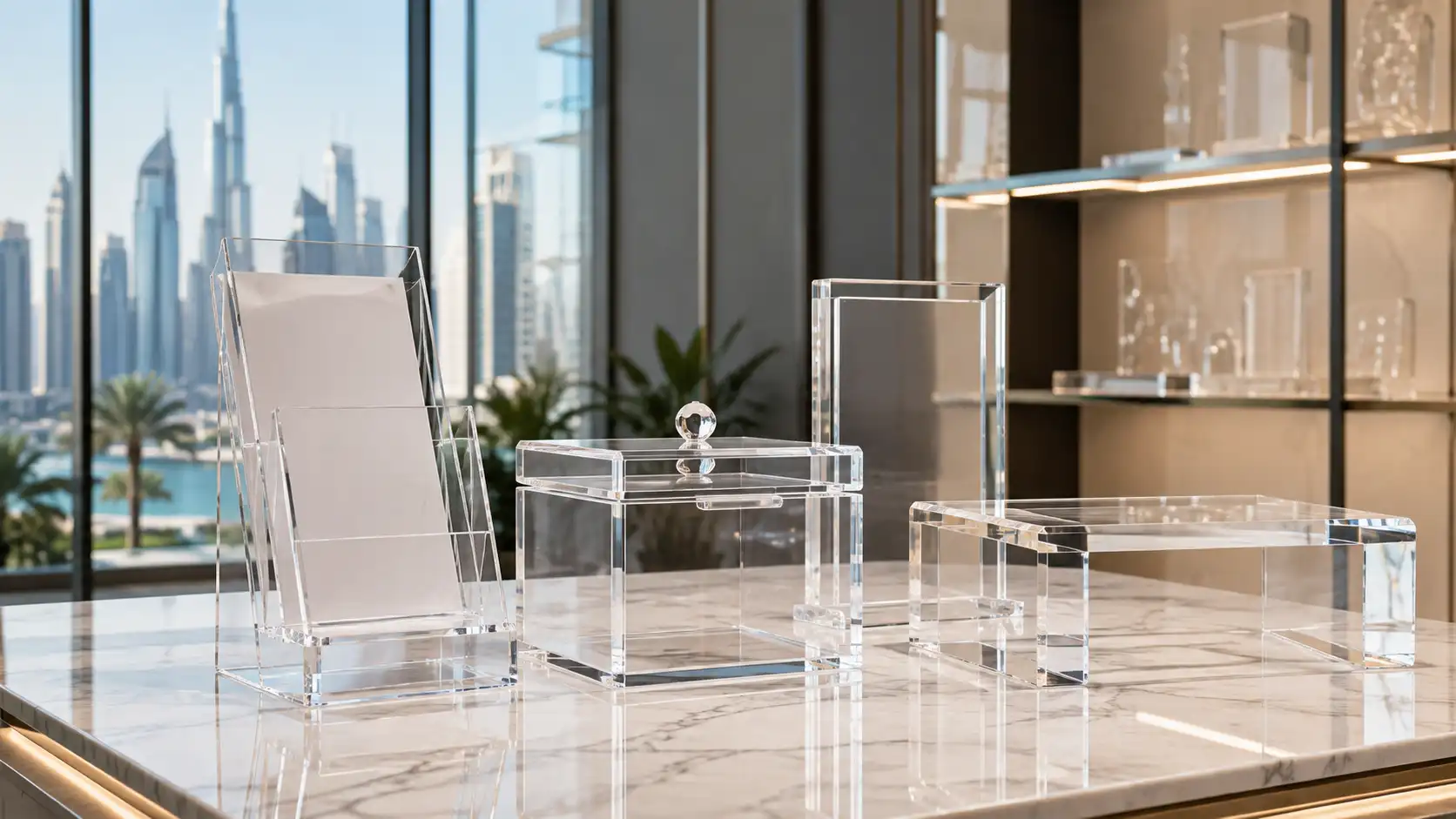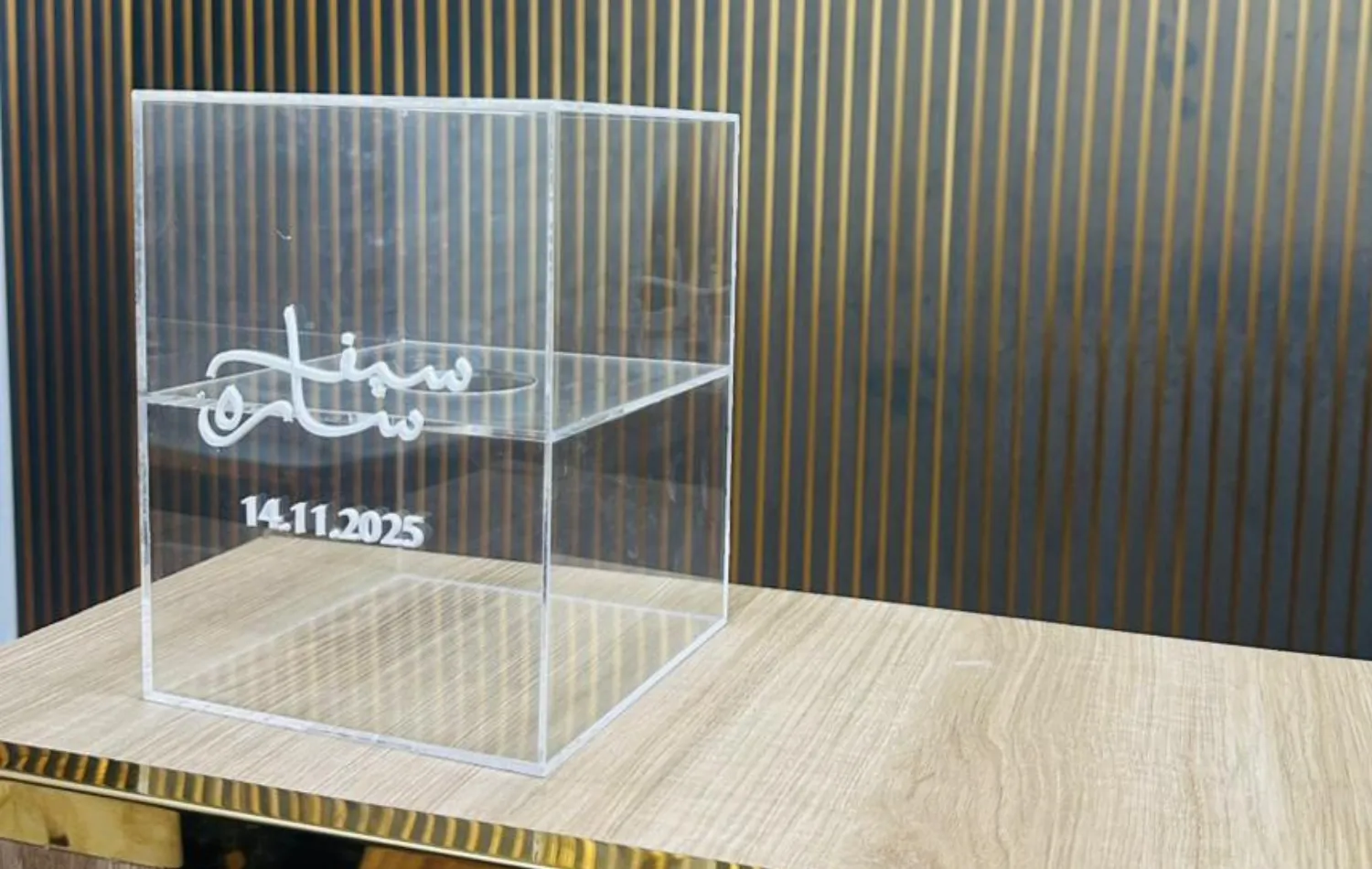
If you’re researching custom acrylic boxes Dubai for a boutique, showroom, luxury brand, corporate team, or event setup, the sections below will help you decide the right thickness, finish, lid style, and branding method—based on how the box will be used.
1) What you’re actually buying (and why it matters)
“Acrylic box” sounds simple, but in real production it can mean many different builds—each one with different performance, durability, and visual results. In Dubai, acrylic boxes are commonly requested for retail product presentation, luxury gifting, corporate packaging, raffle campaigns, display counters, hotel amenities, and secure storage for collectibles or branded items. Some clients want ultra-clear “museum look” presentation. Others need durability for daily handling. Many need both.
The biggest buying mistakes happen when a box is specified only by length x width x height. What makes acrylic boxes look premium and stay strong over time is the combination of: sheet thickness, cut quality, edge finishing, joint method, lid style, and surface finish. That’s why this guide is organized by decisions (specs) rather than only by product photos.
2) Why acrylic is used for boxes in Dubai
Acrylic (commonly PMMA) is popular for display and premium packaging because it can achieve a clean, high-clarity finish with polished edges and sharp geometry—especially when fabricated using controlled cutting and finishing processes. It’s also lighter than glass in many setups and more impact-resistant than glass in typical handling scenarios.
What most buyers like is the “quiet luxury” look: transparent walls, crisp corners, and a clean lid—so the product or item inside becomes the focus. When you add branding (engraving, printing, or raised logos), acrylic boxes work well as a high-end brand touchpoint.
3) Common acrylic box use cases (Dubai market)
Here’s a practical breakdown of common “Dubai-style” requests and what typically matters most in each case:
| Use case | What matters most | Typical spec direction |
|---|---|---|
| Retail product display (counter / shelf) | Clarity, polished edges, stable base, easy-open lid | Clear / ultra-clear, polished edges, optional branded plate |
| Luxury gifting & corporate packaging | Finish quality, branding, internal fit/insert | Frosted/clear + printing/engraving + divider/insert |
| Raffle / donation / ballot boxes | Strength, lock option, slot design, tamper resistance | Thicker panels, reinforced joints, lockable lid |
| Storage / dust protection (collectibles) | Fit, dust control, scratch-resistance, hinge option | Close tolerances, optional hinged lid, premium polishing |
| Showroom / exhibition display | Lighting reflection control, branding visibility | Frosted/clear mix, signage integration, clean edges |
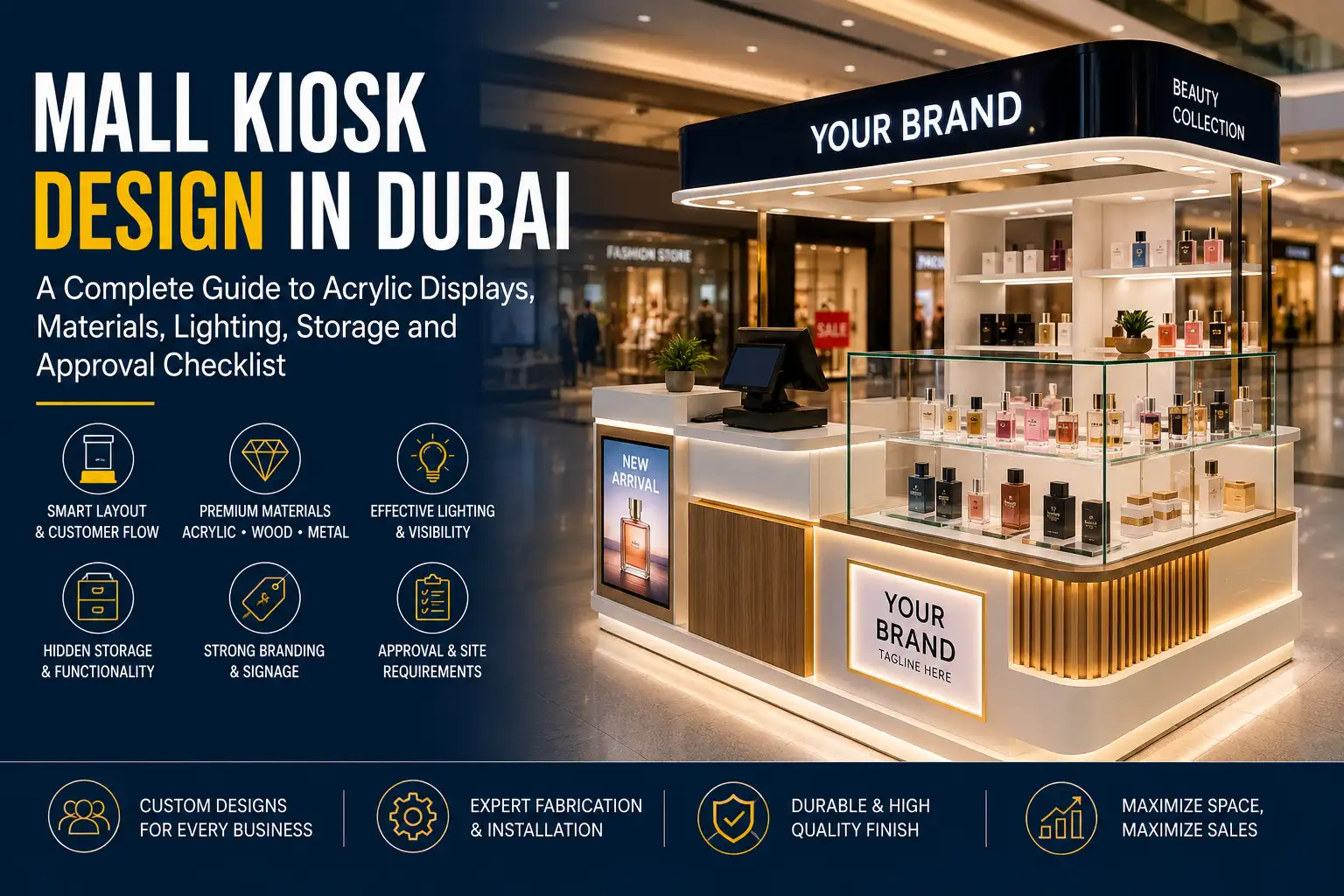
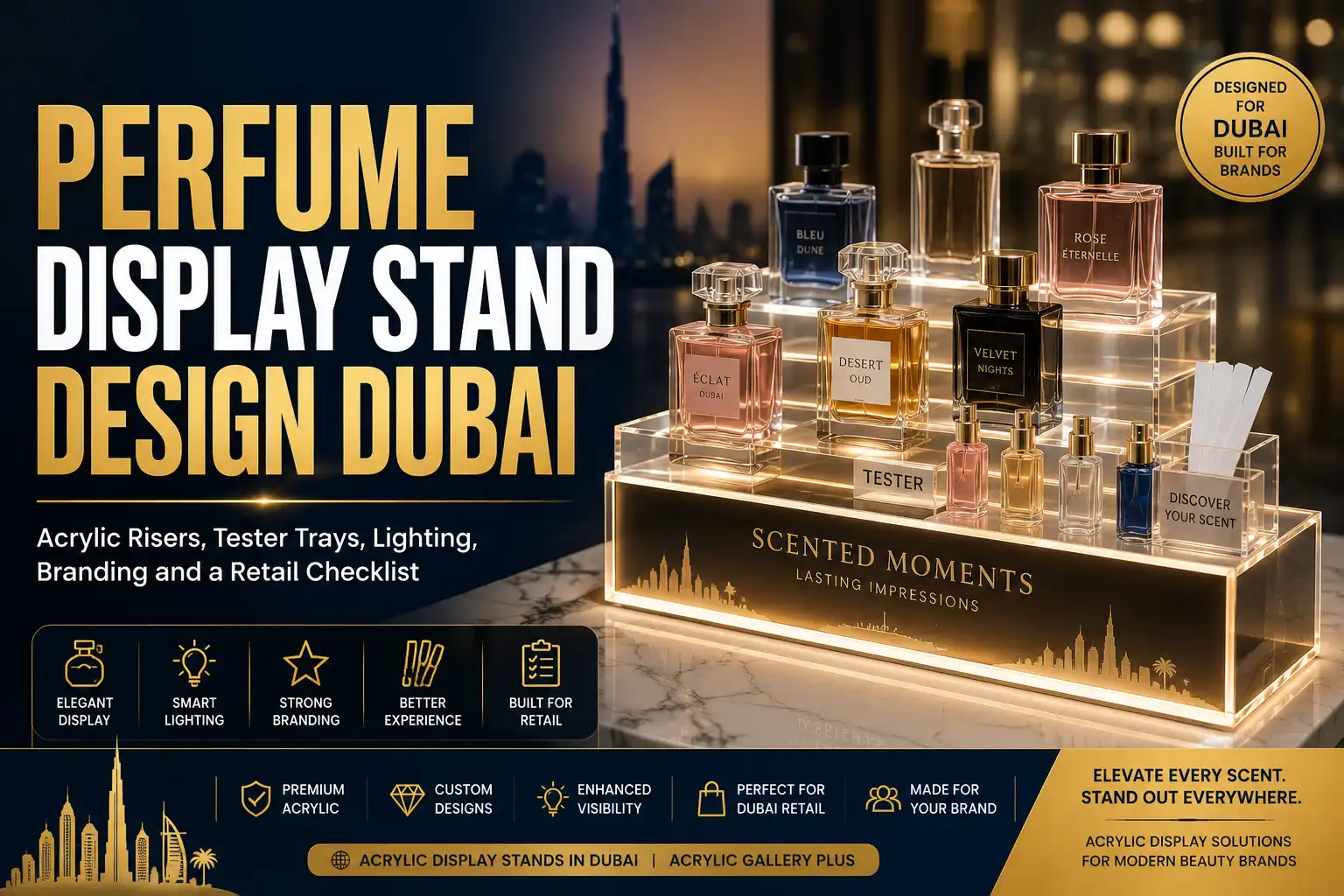
If your requirement is closer to a branded display environment, you may also want to see acrylic display stands in Dubai and acrylic signage in Dubai, because many projects combine boxes + stands + signage as one coherent set.
4) Choosing the right thickness (the decision that affects everything)
Thickness is not only about strength—it also changes the look. Thicker acrylic panels can look more premium because edges appear deeper, and the structure feels solid. But overspecifying thickness can increase cost and weight with no real benefit.
A practical way to choose thickness is to think in terms of span (how wide the panel is) and handling (how often it will be moved, cleaned, opened, stacked, or transported).
| Box size / handling | Good starting thickness | Notes |
|---|---|---|
| Small box (under ~20 cm), light handling | 3–4 mm | Great for compact packaging, inserts, small display covers |
| Medium box (~20–40 cm), normal handling | 4–6 mm | Common retail + corporate use; supports clean lid options |
| Large box (~40–70 cm) or frequent handling | 6–10 mm | Better rigidity; reduces flexing on wide panels |
| Security box / donation / raffle style | 8–12 mm+ | Often combined with locks, reinforced joints, and slots |
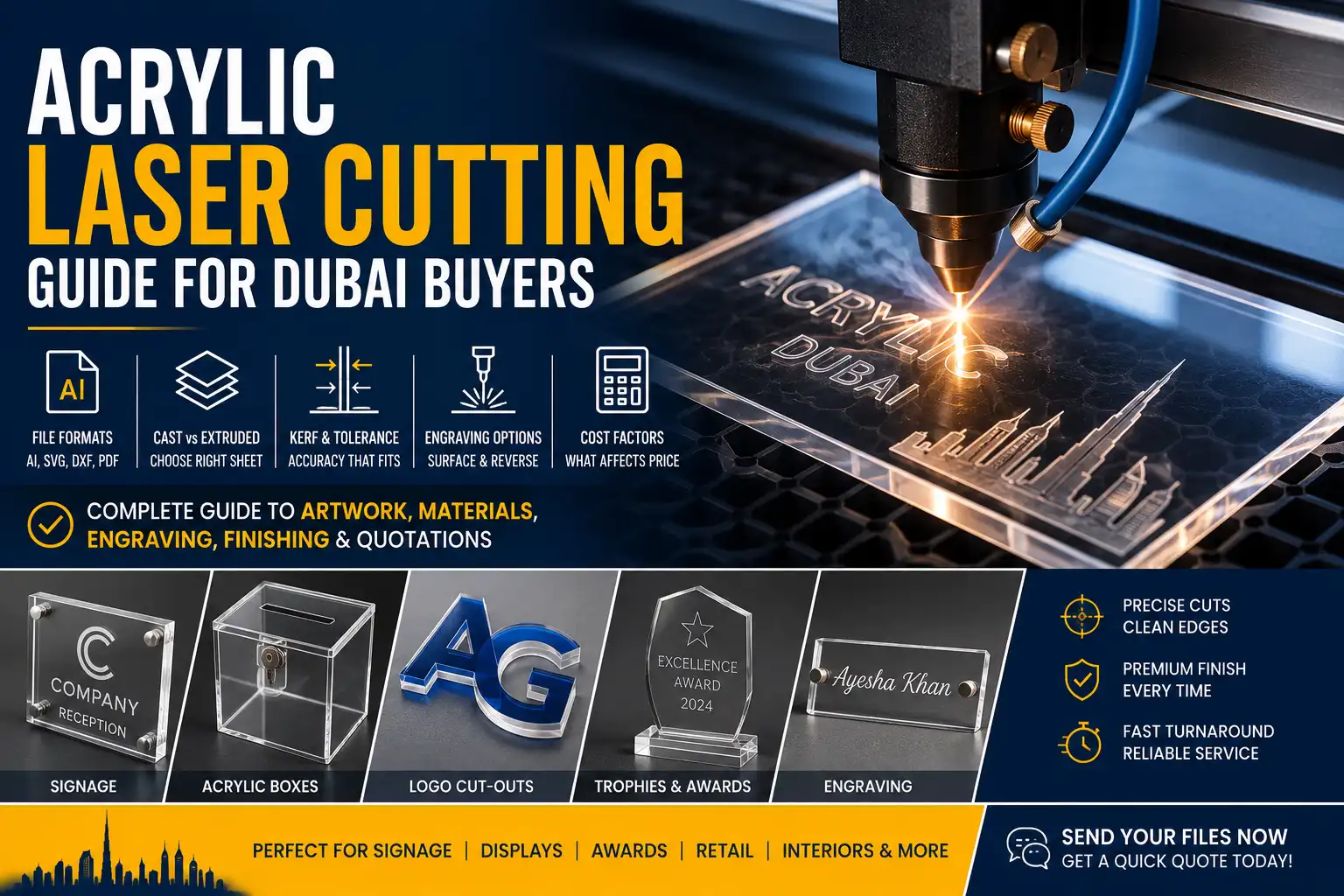
For precision cutting (especially if your design includes internal partitions, branded windows, or complex shapes), CNC and laser both play a role. See CNC routing in Dubai and acrylic laser cutting / engraving in Dubai.
5) Finishes that change the look (clear vs frosted vs color)
Finish is where a “standard acrylic box” becomes a branded product. In Dubai, finishes are often chosen to match interior styling, premium retail identity, or event aesthetics. Here are common options and when to use them:
Clear / ultra-clear
Best for product-first presentation. Ultra-clear choices are popular for luxury retail, perfumes, watches, and collectible displays. Pairing clear panels with polished edges gives the cleanest “gallery look.”
Frosted / matte
Frosted acrylic softens reflections and hides fingerprints better. It’s a strong option for boxes handled frequently or placed under bright lighting. Many brands use frosted panels with a clear lid window to keep the product visible while controlling glare.
Colored / tinted acrylic
Colored acrylic adds strong brand identity. For example, a tinted base with a clear top can make the item feel “framed.” If you plan to use printing or engraving, confirm contrast so the branding reads clearly.
Mirror / metallic styles (project-dependent)
Mirror acrylic can look premium but it scratches more easily and shows dust. It’s best used on accent panels rather than all sides. A common approach is a mirrored base plate with clear side walls.
6) Edges & joints: what “premium finishing” actually means
If you want your box to look expensive, edges and joints must look clean. Buyers often notice: cloudy edges, visible glue marks, uneven corners, and micro-chips. These are avoidable with the right fabrication steps.
Typical production pathways involve: cutting (laser or CNC), edge refinement, polishing, and controlled joining. For projects that require a clean “glass-like” edge, use professional finishing such as edge polishing and finishing in Dubai.
7) Lid styles: lift-off, hinged, magnetic, sliding, lockable
Lid choice affects user experience more than most people expect. If the box is opened often, the lid style becomes part of the product. Below are popular lid choices in Dubai projects:
Lift-off lid
Clean and simple. Works well for display covers and dust-protection boxes. Key is tolerance: too loose looks cheap, too tight scratches edges.
Hinged lid
Practical for frequent access. Hinges can be acrylic-built or hardware-based. If the lid is large, reinforced hinge support matters.
Magnetic lid
A premium packaging feel. Works best when magnets are properly seated and aligned so the closure feels intentional—not “forced.”
Sliding lid
Useful for longer boxes or when top opening space is limited. Requires precise slot machining and smooth finishing.
Lockable lid (raffle/donation/secure storage)
Ideal for raffle campaigns and public placement boxes. If your project needs this category, also review raffle and drop box solutions in Dubai.
8) Branding options that look premium (not like a sticker)
Branding is one of the best reasons to choose acrylic boxes—because it turns packaging into a display object. The right method depends on durability, color needs, and how close people will view the box (counter distance vs hand-held).
Laser engraving
Sharp, elegant, and long-lasting. Works well for logos, names, and minimal brand marks. Often paired with paint-fill for stronger contrast. Explore: acrylic laser engraving in Dubai.
UV printing
Best for full-color brand visuals, gradients, QR codes, and detailed graphics. Useful for retail packaging where branding must match official colors.
Raised lettering / dimensional logos
If you want a premium “3D brand plate” feel, raised acrylic elements are a strong option. This can be done as a plaque or direct letters. See: acrylic 3D letter cutting in Dubai.
Vinyl / decals (project-dependent)
Vinyl can work for short-term campaigns or cost-controlled projects, but premium brands often prefer engraving or printing because it looks more integrated.
9) A Dubai buyer’s QC checklist (use this before approving)
Whether you’re ordering one premium box or a batch for corporate gifting, quality checks should be consistent. Below is a practical checklist you can use when reviewing samples:
| Check | What “good” looks like | Common issues to avoid |
|---|---|---|
| Edge clarity | Even, clean, consistent polish | Cloudy edges, burn marks, micro-chips |
| Corner alignment | Square geometry, consistent seam line | Uneven corners, gaps, visible glue smears |
| Surface condition | No deep scratches, clean protective film handling | Hairline scratches from rough packing/cleaning |
| Lid fit | Smooth open/close, stable placement | Too tight (scratches), too loose (cheap feel) |
| Branding quality | Sharp lines, correct contrast, aligned placement | Misaligned logos, low contrast, weak adhesion |
10) What to share for accurate pricing + faster production
If you want accurate quoting and fewer revisions, send the specs the fabricator actually needs—not only a reference image. A strong order brief includes:
- Exact dimensions (outer size + any inner compartments)
- Purpose (display-only, frequent handling, stacking, secure use)
- Finish (clear/frosted/colored/mirror + preferred look)
- Lid style (lift-off / hinged / magnetic / sliding / lock)
- Branding method (engrave/print/raised logo) + artwork file (AI/PDF/SVG)
- Quantity (one-off, small batch, bulk)
- Deadline (event date, launch date, delivery requirement)
Many projects start from a general fabrication requirement and then branch into specialized parts. If your project includes multiple acrylic items, begin with: acrylic fabrication services in Dubai.
11) Care & maintenance (how to keep it looking new)
Acrylic looks best when cleaned correctly. Use a soft microfiber cloth and a cleaner designed for acrylic/plastics if possible. Avoid harsh abrasives. Also avoid strong ammonia-based glass cleaners because they can dull the surface over time. If you expect frequent handling, consider frosted panels or a design that hides fingerprints.
12) Why sourcing locally in Dubai helps (especially for branded projects)
For branded packaging and display, local fabrication offers practical benefits: faster prototyping, easier sample approvals, quicker revisions, and simpler logistics. When you’re matching brand colors, lid tolerances, or a specific premium look, being able to review a sample quickly can save time and avoid bulk mistakes.
If your requirement is urgent, or if you need design support to finalize a build that’s both durable and premium-looking, the safest next step is to share your use case and request a spec recommendation.
Frequently Asked Questions About Custom Acrylic Boxes in Dubai

About Acrylic Gallery Plus
Acrylic Gallery Plus provides custom acrylic fabrication in Dubai for retail, corporate, event, and fit-out requirements—covering acrylic boxes, display solutions, engraving, CNC routing, and finishing. See our main pages: About Us and Contact.
Content intent: practical buyer guidance + production specs you can approve with confidence.